
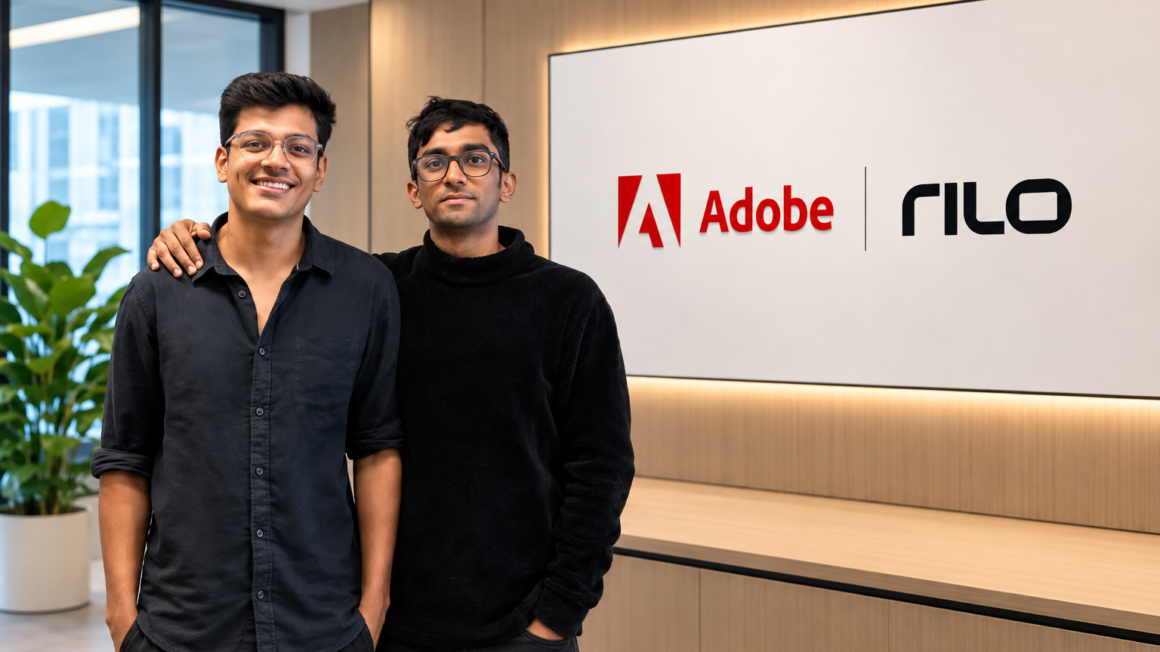
The deal brings Rilo’s AI workflow technology and six-person team into Adobe as the software group expands its agentic AI strategy across marketing, customer experience and enterprise automation.
Adobe has acquired Rilo, an India-based artificial intelligence startup focused on automating complex marketing and go-to-market workflows, adding another piece to the software company’s expanding push into agentic AI.
Rilo announced on August 24 that it had been acquired by Adobe and was winding down its standalone hosted product. Adobe subsequently confirmed the transaction to TechCrunch, which reported that the deal involves technology licensing and the acquisition of Rilo’s team. Financial terms were not disclosed.
The transaction is relatively small compared with Adobe’s multibillion-dollar acquisitions, but its strategic significance lies elsewhere. Rilo has been building software designed to let AI agents carry out multi-step business workflows rather than simply generate content or respond to individual prompts.
That capability aligns closely with Adobe’s effort to make autonomous and semi-autonomous AI agents a core part of the technology used by large marketing organizations.
Rilo built AI around outcomes, not isolated tasks
Founded in 2025 by IIT Bombay batchmates Dhruv Jaglan and Georgi Boby, Rilo developed an AI workflow platform aimed particularly at marketing and go-to-market teams.
Its technology allowed users to describe a workflow in natural language and use AI agents to build and execute processes involving multiple tools. Business Standard reported that those workflows ranged from competitive intelligence and prospecting to social-media research, outreach and campaign analysis.
TechCrunch reported that Rilo was also being used for content repurposing and distribution, competitor intelligence and sales-call analysis. More than 10,000 people had tried the product, according to co-founder Jaglan.
The underlying concept was broader than conventional workflow automation.
Rilo said it had been developing persistent AI systems capable of researching information, reasoning about tasks, operating across different software tools and bringing people into the process when human judgment was required. In announcing the Adobe deal, the company specifically highlighted its work around agents, orchestration and human-in-the-loop systems.
That architecture reflects one of the central shifts taking place across enterprise AI.
Generative AI initially spread through businesses primarily as a tool for producing text, images, code and analysis. Agentic systems are attempting to move further: from generating an output to carrying out a sequence of actions needed to achieve a defined business objective.
For marketers, that could mean an AI system that does more than draft campaign copy. An agent could potentially analyze customer information, identify an audience, coordinate content production, prepare campaign assets, initiate workflows across different applications, evaluate performance signals and recommend subsequent actions.
Adobe increasingly wants its software to provide the infrastructure behind those processes.
Why Rilo fits Adobe’s agentic AI strategy
Adobe began setting out that strategy publicly well before the Rilo acquisition.
In March 2025, the company introduced Adobe Experience Platform Agent Orchestrator, designed to let businesses build, manage and coordinate AI agents from Adobe and third-party technology providers.
At launch, Adobe also announced ten purpose-built agents for functions including audience refinement, website optimization, data management and repetitive content-production tasks.
By September 2025, Adobe had made its first set of enterprise AI agents generally available, positioning Agent Orchestrator as a platform through which agents could understand business context, plan multi-step actions and work across customer-experience and marketing processes.
The strategy became substantially broader in April 2026 when Adobe introduced CX Enterprise, which it describes as an end-to-end agentic AI system spanning customer data, content, customer engagement and brand visibility.
Adobe said the system incorporates AI agents, agent skills, Model Context Protocol endpoints and governance mechanisms intended to make automated workflows reliable and auditable. The company also said more than 20,000 global brands use its enterprise applications and that Adobe Experience Platform powers more than one trillion experiences annually.
Rilo therefore enters Adobe at a point when the company is no longer experimenting with agents as isolated product features.
It is attempting to build an operating layer for enterprise marketing in which specialized AI agents can coordinate work across multiple applications, datasets and business processes.
Rilo’s experience building cross-tool workflows and agent orchestration makes the startup a logical fit within that effort.
Adobe wants to connect insight with execution
One of the central problems Adobe is trying to address is fragmentation.
Large marketing organizations typically operate across separate systems for customer data, analytics, content creation, campaign management, personalization, commerce and measurement. Connecting those systems often requires manual coordination between teams or predetermined automation rules.
Agentic AI introduces the possibility of software working across those boundaries more dynamically.
Adobe’s CX Enterprise Coworker, announced in April, is designed around precisely that concept. The company says the system can monitor signals, recommend actions and execute customer experiences across channels according to defined objectives while keeping people involved in the workflow.
Rilo had been pursuing a similar idea from the perspective of a much smaller AI-native startup.
That makes the acquisition potentially more valuable as a capability and talent transaction than as the purchase of an established revenue-generating software platform.
TechCrunch reported that Adobe will integrate some of Rilo’s intellectual property along with its six-member team. Adobe confirmed the deal but declined to provide additional details about its plans for the technology.
Rilo’s hosted application has already been withdrawn. New registrations have been closed, and the startup has told customers that the standalone product is being wound down as its team joins Adobe.
A rapid exit for a young Indian AI startup
The acquisition also represents an unusually fast outcome for Rilo.
The company was founded in 2025 and had raised approximately $1 million from investors including Peak XV Partners, DeVC and Day Zero Ventures, according to TechCrunch. The publication reported that the funding had valued the company at roughly $10 million.
Business Standard reported that Rilo was launched in September 2025, meaning the Adobe transaction came less than a year after the startup began operating.
The speed of the acquisition illustrates another feature of the current AI market: established software companies are increasingly competing not only for mature products but for small technical teams that have demonstrated an ability to build useful agent architectures.
For companies such as Adobe, acquiring a specialist team can provide engineering expertise and working technology in an area where the underlying AI infrastructure is evolving rapidly.
The transaction is also Adobe’s second known acquisition of an Indian technology company following its purchase of Bengaluru-based generative AI video startup Rephrase.ai in 2023.
Adobe is assembling a broader AI marketing platform
Rilo is not an isolated acquisition.
Adobe completed its acquisition of digital marketing and brand-visibility company Semrush in April 2026 after agreeing to buy the business for approximately $1.9 billion.
The Semrush transaction expanded Adobe’s capabilities in search visibility and, increasingly, how brands appear inside AI-powered discovery systems. Adobe has subsequently integrated Semrush capabilities into its broader brand-visibility products.
The two transactions operate at dramatically different scales but point toward the same strategic direction.
Semrush strengthens Adobe’s ability to understand how brands are discovered across search engines and AI interfaces. Rilo brings experience in building agents capable of carrying out workflows.
Adobe’s existing portfolio provides the other layers: customer data through Adobe Experience Platform, analytics, content management, journey orchestration, marketing content production and generative AI through Firefly and related products.
Taken together, Adobe is attempting to connect data, intelligence, content and execution rather than treating them as independent marketing functions.
The economic importance of that business is already considerable.
Adobe reported $5.86 billion in Digital Experience revenue in fiscal 2025, an increase of 9% from the previous year. Digital Experience subscription revenue rose 11% to $5.41 billion. Adobe identified AI-powered products and integrated workflows as important elements of its strategy for the segment.
Agentic AI is now becoming part of the company’s effort to extend that business.
The enterprise challenge is reliability, not simply autonomy
The promise of AI agents is straightforward: allow software to perform more work with less continuous human direction.
The enterprise challenge is more complicated.
Marketing systems routinely work with customer information, proprietary content, brand guidelines, budgets and business-critical decisions. Increasing the autonomy of those systems also increases the importance of permissions, data governance, auditability and controls over what an agent is allowed to do.
Adobe has therefore emphasized governance as part of its enterprise AI architecture rather than presenting autonomy as an end in itself.
CX Enterprise includes an intelligence and governance layer, while Adobe has described its agentic systems as supporting auditable workflows and interoperability with third-party platforms.
Rilo’s own emphasis on human involvement when judgment is required fits that enterprise model.
Ultimately, the competitive question will not be which software company can claim the largest number of AI agents.
It will be which platforms can make those agents reliably useful inside real corporate workflows.
A small acquisition with a clear strategic signal
There is still much that Adobe has not disclosed about Rilo.
The company has not announced the financial value of the transaction, detailed exactly which Adobe products will incorporate Rilo’s technology or provided a timetable for integration.
Those unanswered questions make it premature to describe Rilo as a transformative acquisition for Adobe.
But the direction is clear.
Adobe spent the first phase of generative AI embedding models into creative and productivity applications. Its enterprise strategy is increasingly focused on the next layer: systems capable of understanding business context, coordinating multiple agents and moving from recommendation to action.
Rilo had spent its short life trying to solve precisely that problem.
Its independent product is disappearing, but its technology and team are entering a company with a far larger enterprise customer base and an increasingly explicit ambition to make agentic AI central to modern marketing infrastructure.
For Adobe, the Rilo acquisition is another step in a broader transition: from providing software that helps marketers perform individual tasks to building intelligent systems capable of orchestrating the work around them.