
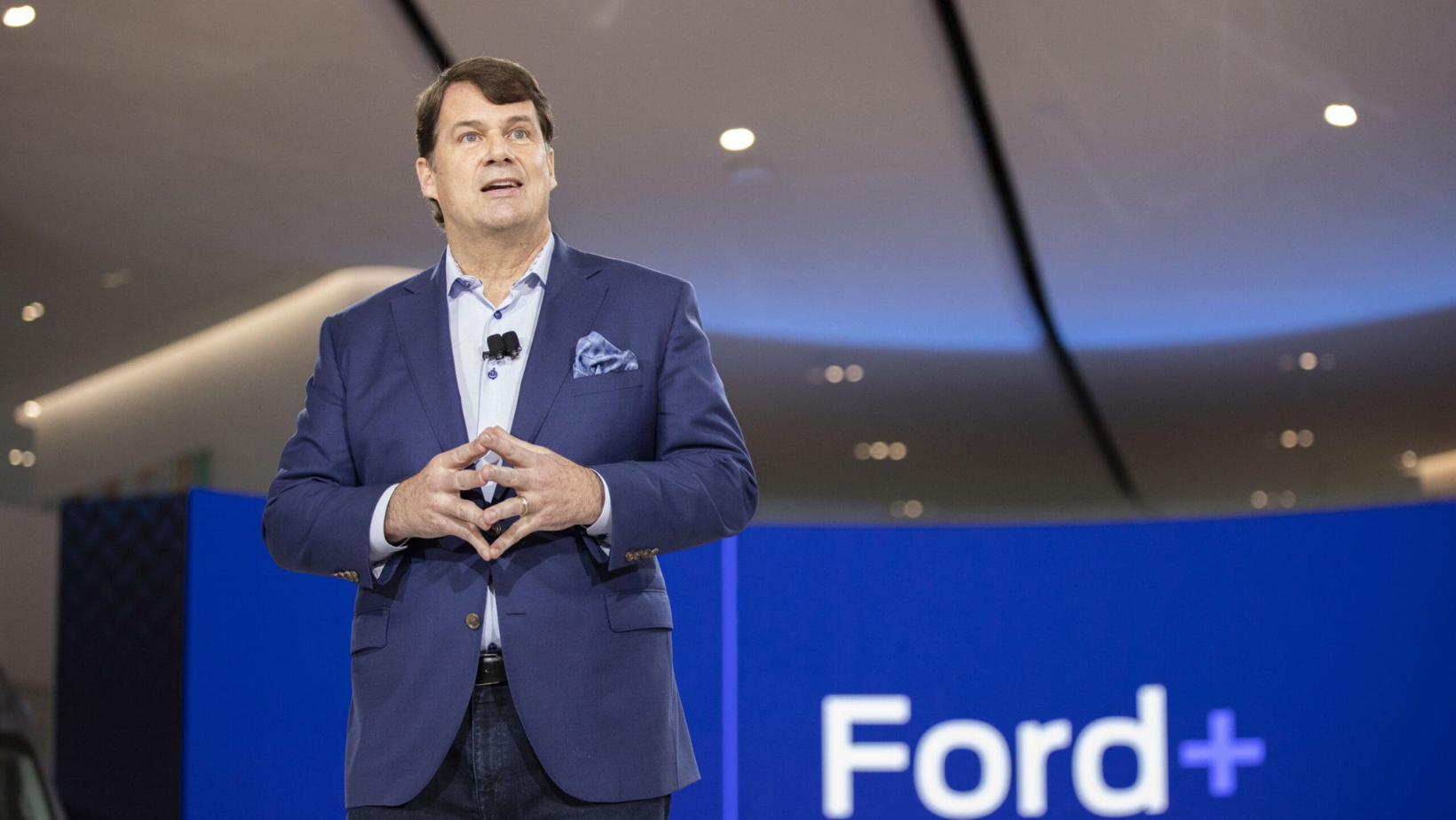
Ford’s Wake-Up Call: Jim Farley Admits Tesla and Chinese EV Makers Left Ford “Shocked” — What This Means for the Global EV Race
Ford Motor Company, one of America’s most iconic automakers, is undergoing a major transformation — and it all started with a surprising moment of humility. CEO Jim Farley recently revealed that his team was “shocked” when engineers tore down a Tesla Model 3 and several top Chinese electric vehicles. The findings were not only eye-opening, but a clear warning that Ford must accelerate innovation or risk falling behind in the world’s fastest-growing automotive segment.
This revelation spotlights a pivotal shift in global automotive competition — a race increasingly dominated by Tesla and Chinese EV manufacturers, who are combining efficiency, software leadership, and cost advantages in ways traditional automakers didn’t foresee.
A Teardown That Changed Everything
Jim Farley’s comments came while discussing Ford’s EV challenges. His engineers dismantled a Tesla Model 3 and multiple Chinese EVs in an effort to benchmark Ford’s own electric platforms. Teardowns are a standard competitive strategy — but this one hit harder than expected.
What Ford discovered:
- Tesla’s wiring architecture was drastically more efficient.
Ford’s Mustang Mach-E reportedly used 1.6 km more wiring than a Tesla Model 3. More wiring means more weight — and heavier EVs require bigger, more expensive battery packs. - Chinese EVs were even more advanced in software integration.
Farley highlighted that brands such as BYD, NIO, and others have seamlessly integrated systems from Huawei and Xiaomi — allowing a user’s entire digital life to sync the moment they step into the car. - Cost efficiency was a major shock.
Chinese EV manufacturers operate at scale with lean supply chains, making their vehicles significantly cheaper to produce without compromising quality or tech.
Farley admitted the experience was humbling — and a catalyst for major internal change.
China’s EV Ecosystem: The World’s Most Advanced Market
Farley emphasized that Ford is not just competing with Tesla — it’s competing with an entire ecosystem of Chinese EV companies that have surged ahead with innovation, affordability, and software excellence.
Key market realities:
- Nearly 50% of all new cars sold in China are electric.
- The U.S. lags far behind, with electric vehicles making up only about 10% of total new car sales.
- China’s EV leaders are backed by robust technology ecosystems, strong supply chains, and government policies that aggressively support electrification.
Tesla may be the world’s most recognized EV brand, but in China, domestic automakers are outpacing both legacy companies and global EV pioneers in volume, affordability, and innovation.
Ford’s Strategic Response: A Deep Transformation Underway
The “shock” sparked one of the most significant strategic moves in Ford’s recent history — the creation of Ford Model E, a dedicated division focused entirely on electric vehicles.
Why Model E matters:
- It aims to redesign Ford’s EV platforms from the ground up.
- The division is tasked with simplifying architectures, reducing wiring, and enhancing software capabilities.
- It is pursuing Tesla-like efficiencies in manufacturing, design, and cost structure.
Despite these efforts, the division reported over $5 billion in losses in 2024, highlighting how difficult — and expensive — the transition to electrification truly is.
Still, Farley insists innovation is the only path forward:
“You have to take on the hardest problems as fast as you can… sometimes in public, because you’ll solve them quicker that way.”
The Battle for Software: Where Legacy Automakers Struggle Most
Farley has repeatedly acknowledged that Ford must evolve beyond being simply a mechanical engineering company. Modern EVs are computers on wheels, and Tesla — along with Chinese manufacturers — dominate the software space.
Where competitors lead Ford:
- Over-the-air updates that enhance performance and features
- Unified vehicle operating systems instead of fragmented electronics
- AI-driven dashboards and smart cabin experiences
- Superior battery management software
To close the gap, Ford had even explored building an integrated “electronic brain” similar to Tesla. However, the project was later discontinued due to feasibility challenges — underlining how difficult catching up really is.
Why This Shift Matters for Global Competition
Farley’s revelation is more than a candid admission. It’s a sign of a deeper shift in the global auto industry — a shift defined by four major forces:
1. EV Leadership = Technology Leadership
Success in the EV era isn’t about engines or metal stamping — it’s about chips, software, battery chemistry, and digital ecosystems.
2. China Has the Scale Advantage
China produces over half of the world’s EVs, giving its manufacturers cost and supply chain efficiency that Western automakers can’t easily match.
3. Tesla Set the Benchmark
Tesla’s simplified wiring, centralized electronics, and software-first design approach have become the blueprint for modern EVs.
4. Legacy Automakers Must Reinvent Themselves
Companies like Ford face the immense challenge of modernizing decades of manufacturing systems built for gasoline-powered cars.
The Road Ahead for Ford: Challenges & Opportunities
Key challenges Ford must overcome:
- High EV production costs
- Lagging software capabilities
- Supply chain limitations for batteries and chips
- Strong competition from Tesla and fast-rising Chinese brands
Opportunities Ford can leverage:
- A strong brand and loyal customer base
- Deep manufacturing experience
- Growing EV adoption in North America
- Strategic partnerships in battery tech and software
- A focus on trucks and SUVs — segments where Tesla and Chinese brands are still expanding
Farley appears determined to reposition Ford as a serious EV competitor, but success will require aggressive innovation, bold decisions, and continued investment.
Conclusion: Ford’s “Shock” Is the Push It Needed
Jim Farley’s candid admission underscores a defining moment not only for Ford, but for the entire U.S. auto industry. Tesla and Chinese EV makers have set a new standard — one built on efficiency, software fluency, and speed of innovation.
For Ford, the teardown wasn’t just a technical insight; it was a wake-up call.
The company now faces a fierce global competition — but also an opportunity to redefine itself for the electric future. If Ford can absorb the lessons from its rivals and accelerate its EV strategy, it could still emerge as a strong contender in what Farley has called “the biggest transformation in the history of our industry.