
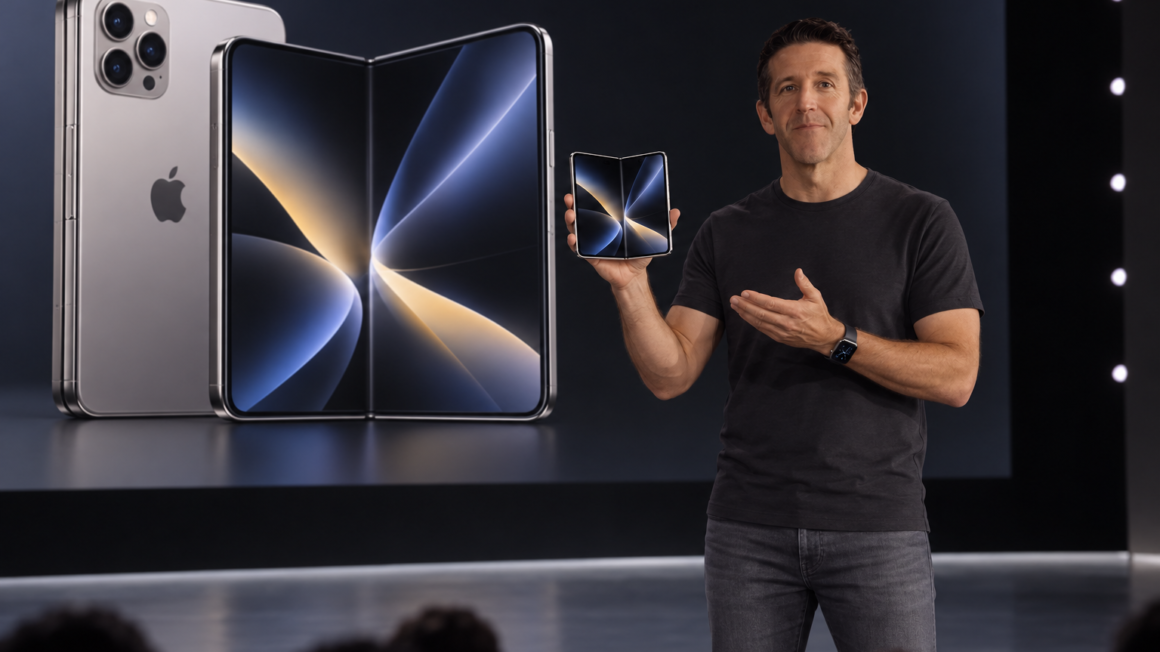
Apple’s first major product event under Chief Executive John Ternus could introduce the company’s first foldable iPhone, opening a new chapter for its most important product while testing whether Apple can reshape a category that Samsung, Huawei and other rivals have spent years developing.
Apple is preparing for one of the most consequential iPhone launches in years, with the technology group widely expected to unveil its first foldable smartphone at a September 9 product event that will also mark the first major launch under newly appointed Chief Executive John Ternus.
Apple has officially confirmed a special event for September 9 at 10 a.m. Pacific Time under the tagline “Surprise and shine.” The company has not publicly confirmed a foldable iPhone or disclosed its specifications, price or availability ahead of the presentation.
Reporting from Reuters, however, says Apple is expected to introduce its first folding iPhone alongside its latest premium devices, representing what could be the most dramatic change to the physical design of the iPhone since Apple removed the home button with the iPhone X in 2017.
The timing makes the launch particularly significant.
Ternus became Apple’s CEO on September 1, 2026, succeeding Tim Cook after 15 years of leadership. Cook has moved into the role of executive chairman, while Ternus has joined Apple’s board of directors. Apple announced the succession in April following what it described as a long-term planning process unanimously approved by the board.
Only eight days into his tenure, Ternus is now preparing to oversee a product launch that could define the opening phase of his leadership.
For Apple, the stakes extend well beyond adding another device to the iPhone lineup.
A foldable would give the company an opportunity to create an entirely new premium tier within a franchise that generated more than $209.5 billion in fiscal 2025, roughly half of Apple’s $416.2 billion in annual revenue.
It also presents a much larger strategic question: whether Apple can once again enter an established technology category relatively late and use its combination of engineering, software, ecosystem integration and enormous installed customer base to reshape the market.
John Ternus begins his tenure with a major hardware test
Few incoming chief executives inherit a company as financially powerful as Apple.
Fewer still face a defining product event little more than a week after taking control.
Ternus’s elevation to CEO is particularly relevant to the expected foldable iPhone because his career inside Apple has been built around hardware engineering.
He joined Apple’s product design organization in 2001, became a vice president of Hardware Engineering in 2013 and joined the executive team as senior vice president of Hardware Engineering in 2021.
Apple says Ternus has overseen engineering work across iPhone, Mac, iPad, Apple Watch and other product categories, and was instrumental in the introduction of product lines including the iPad and AirPods. His responsibilities have also included work around product durability, materials and repairability.
His appointment therefore represents more than a leadership change.
Apple has placed an engineer with decades of direct product-development experience at the top of the company at a moment when advances in artificial intelligence, new device architectures and increased competition are changing the technology industry.
The expected foldable iPhone will provide an immediate test of that product-focused leadership.
Tim Cook, meanwhile, remains involved as executive chairman. Apple has said Cook will assist with certain areas of the business, including engagement with policymakers around the world.
The structure gives Apple continuity while putting responsibility for its next product era firmly in Ternus’s hands.
The foldable iPhone remains unconfirmed — but expectations are unusually high
Apple has deliberately revealed little about what will be announced at its September event.
The company has confirmed the date and presentation but has not publicly identified a foldable device.
That distinction matters.
Until Apple announces the product, details surrounding its form factor, specifications, pricing and release schedule remain expectations based on reporting, analyst research and supply-chain information rather than confirmed Apple disclosures.
Reuters reported on September 9 that Apple is expected to unveil a book-style folding iPhone that could cost more than $2,000, immediately placing it among the most expensive products in the smartphone market.
A separate Reuters analysis published ahead of the event said expectations for the premium device extend beyond $2,500 in some forecasts, while analysts are watching closely for Apple’s approach to the hinge, display crease and overall durability.
Those engineering challenges have been central to the foldable category since commercial devices first reached consumers.
A smartphone that repeatedly opens and closes introduces stresses that conventional phones do not face. Manufacturers have had to improve flexible displays, hinges, water resistance, structural rigidity and overall device thickness while attempting to make the internal screen feel increasingly similar to a conventional display.
Apple’s long delay in entering the category may have given it time to observe those problems.
But it also raises expectations.
Consumers paying well above the price of a conventional flagship iPhone are unlikely to accept a product that feels experimental simply because it folds.
Apple is entering a market competitors built first
Apple would not be entering an empty market.
Samsung, Huawei, Google, Motorola, Xiaomi and other manufacturers have already spent years developing folding smartphones.
Samsung remains the global leader, while Huawei has built a particularly powerful position in China.
Competition has intensified immediately ahead of Apple’s event. Huawei and Xiaomi both introduced new foldable models this week, including Huawei’s high-end Mate XT2 and Xiaomi’s Xiaomi 18 Fold.
Apple’s arrival therefore would not establish the foldable category.
Its significance lies in potentially taking the category mainstream within the premium smartphone market.
That is a familiar pattern in Apple’s history.
Apple did not invent the smartphone, tablet computer, smartwatch, digital music player or wireless earbud. Instead, some of its most successful products entered categories where technologies already existed and combined industrial design, software, custom silicon, services and distribution into a more tightly integrated consumer proposition.
The foldable iPhone will be judged against that standard.
Simply producing a screen that bends will not be enough.
The more important question is whether Apple can make the folding form factor meaningfully useful.
Why a folding screen could matter to Apple’s ecosystem
The potential value of a foldable extends beyond making a phone physically different.
A book-style device can provide a conventional smartphone display while closed and a substantially larger workspace when opened.
That creates new possibilities for multitasking, productivity, media consumption and increasingly AI-assisted workflows.
Counterpoint Research expects book-style devices to become an increasingly important part of the foldable market. Its June forecast estimated that book-type models could account for 76% of global foldable smartphone shipments in 2026, up from 52% in 2025.
The research group has also argued that wider displays could become increasingly valuable as AI software moves beyond simple chat interfaces toward tasks involving multiple applications and information sources.
That could be strategically important for Apple.
The company controls the operating system, processor architecture, application ecosystem and major services running across the iPhone. A larger folding display would give Apple an opportunity to integrate elements of the iPhone and iPad experience while developing software specifically around the changing screen geometry.
If successful, the differentiation would come not from the hinge itself but from what Apple’s software can do with it.
Foldables remain small — but Apple could change the economics
Despite years of development, folding smartphones remain a relatively small part of the global handset business.
But industry forecasts suggest Apple’s arrival could significantly accelerate the category.
Counterpoint Research said this week that cumulative foldable smartphone shipments are expected to exceed 100 million devices by the end of 2026.
It forecasts Apple could ship as many as 6 million foldable iPhones in 2026, giving the company approximately 25% of the global foldable market despite its short initial selling period.
Under the same forecast, Samsung would retain the leading position with approximately 38% of shipments, followed by Apple at 25% and Huawei at 22%.
Those are forecasts, not sales results, and Apple’s actual performance will depend on pricing, production capacity, availability and consumer response.
But they illustrate why the launch matters to the wider smartphone industry.
Apple’s scale means even a relatively small percentage of its customer base could materially alter foldable volumes.
Counterpoint separately expects foldable smartphone shipments to grow around 21% year over year in 2026, while its display research forecasts foldable panel shipments of approximately 27.5 million units, an increase of around 24% from 2025.
IDC is similarly bullish about Apple’s potential impact.
The research firm forecasts Apple could ship more than 17 million foldable iPhones by 2027, representing roughly 40% of the worldwide foldable market. IDC estimates the devices could generate more than $45.7 billion in market value by that point.
Again, these figures are analyst projections rather than Apple guidance.
But collectively they suggest the industry sees Apple’s entry as a potential structural change rather than another incremental smartphone release.
A $2,000-plus iPhone would create a new luxury tier
Price will be central to the commercial strategy.
If reports of a price above $2,000 prove accurate, Apple’s foldable would sit considerably above its conventional flagship smartphones.
That could limit initial volumes while simultaneously making the product economically attractive.
A foldable does not necessarily need to replace tens of millions of standard iPhones immediately to become a meaningful business.
Apple could instead use it to establish a tier above the traditional Pro lineup, targeting existing customers prepared to pay significantly more for a new form factor.
Counterpoint expects the weighted average wholesale price of foldable smartphones to increase by 18% in 2026, partly because of Apple’s expected entry and a greater concentration of premium book-style devices.
Its research projects that products priced above $1,600 could represent around 60% of foldable shipments this year.
Apple is particularly well positioned to test that upper end of the market because of the purchasing power of its installed user base.
The company said in January that its active installed base had exceeded 2.5 billion devices worldwide.
Even limited conversion from that ecosystem could produce significant demand.
The iPhone remains Apple’s economic engine
The strategic importance of the launch becomes clearer when viewed through Apple’s financial statements.
During fiscal 2025, Apple generated:
- $416.2 billion in total net sales;
- $209.6 billion from the iPhone;
- $109.2 billion from Services;
- and $112 billion in net income.
That means the iPhone alone produced slightly more than half of Apple’s annual sales.
The business has remained strong into 2026.
Apple reported $109.4 billion in revenue for its fiscal third quarter ended June 27, 2026, up 16% year over year. The company described it as its strongest June quarter and said iPhone, Mac and Services revenue each set June-quarter records.
The foldable is therefore not a rescue attempt for a collapsing iPhone franchise.
Apple is trying to create another growth layer around a product that remains enormously profitable and commercially powerful.
That is important because the smartphone market itself is mature.
Consumers increasingly keep premium phones for longer periods, incremental camera and processor upgrades are less transformative than they were a decade ago, and manufacturers must work harder to create compelling reasons for customers to upgrade.
A new physical form factor could provide Apple with something conventional annual improvements cannot: an immediately visible distinction between one generation of iPhone and another.
The launch could also reshape Apple’s annual iPhone cycle
The expected hardware changes may be accompanied by an important shift in how Apple releases smartphones.
Reuters reports that Apple is expected to concentrate its autumn launch around premium models, including the foldable and Pro devices, while moving some lower-priced iPhone updates into a later release window.
If adopted, that would represent a significant change to Apple’s traditional product cadence.
For years, the September iPhone launch has generated an enormous concentration of demand during the final months of the calendar year.
Separating product introductions could give Apple more opportunities to stimulate consumer demand throughout the year while allowing individual device families more space in its marketing cycle.
For a premium foldable, that could be particularly useful.
Rather than presenting it simply as one model among several new phones, Apple could establish the foldable as a distinct category sitting at the top of the iPhone portfolio.
Ternus also inherits Apple’s AI challenge
Hardware will not be the only measure of Ternus’s early leadership.
Apple is navigating an industry increasingly defined by artificial intelligence.
The company used its Worldwide Developers Conference in June to introduce a new generation of Siri powered by Apple Intelligence, making AI a major part of its software roadmap. Apple’s official event archive describes the new Siri as one of the central announcements of WWDC 2026.
That creates an important connection with the foldable.
A larger display could become more valuable if AI systems increasingly work across applications, compare information, generate content and assist users through multi-step workflows.
In that environment, Apple’s strategic advantage would not necessarily come from having the largest AI model.
It could come from controlling the device, operating system, applications, processors and user experience through which AI is delivered.
For Ternus, whose professional history is primarily associated with hardware, demonstrating that connection between physical products and intelligent software may become one of the defining challenges of his tenure.
Apple’s late-entry strategy faces another major test
There is an inherent tension in Apple’s approach to new product categories.
Entering late allows the company to observe technology as it matures, wait for suppliers to improve manufacturing processes and learn from the weaknesses of early competitors.
But the longer Apple waits, the greater the expectation that its eventual product must be substantially better.
That is especially true of foldables.
Samsung and Huawei have already moved through multiple generations. Consumers understand what folding phones look like. The novelty of simply opening a smartphone into a larger display has faded.
Apple therefore needs to provide a reason why its version should matter.
That could come through durability, industrial design, battery efficiency, software, ecosystem integration, artificial intelligence or some combination of all five.
The company’s history suggests that it does not need to be first.
But it does need to make being late look deliberate.
A defining opening act for Apple’s new CEO
The September 9 event brings together two unusually important moments for Apple.
One is a generational leadership transition.
The other could be the largest physical change to the iPhone in nearly a decade.
Tim Cook leaves Ternus an extraordinary business: annual revenue above $400 billion, more than 2.5 billion active devices and one of the world’s most valuable consumer technology ecosystems.
But Ternus also inherits difficult questions about the future.
Can Apple create another meaningful hardware growth category?
Can it turn foldables from an expensive niche into a mainstream premium format?
Can its hardware and software become the preferred platform for increasingly sophisticated artificial intelligence?
And can Apple continue finding reasons for customers to upgrade the iPhone nearly two decades after the device transformed the company?
The expected foldable will not answer all of those questions in one product cycle.
But it could provide the first meaningful indication of how John Ternus intends to answer them.
For Apple, September 9 may therefore represent considerably more than another annual iPhone launch.
It could mark the beginning of the post-Cook product era — and the first major test of whether Apple’s new CEO can turn one of the company’s biggest hardware bets in years into its next major growth platform.
At the time of publication on September 9, 2026, Apple had confirmed its September product event but had not officially announced a foldable iPhone. Product specifications, pricing, sales forecasts and release expectations cited in this article are attributed to Reuters and independent industry research and should not be interpreted as confirmed Apple disclosures.