
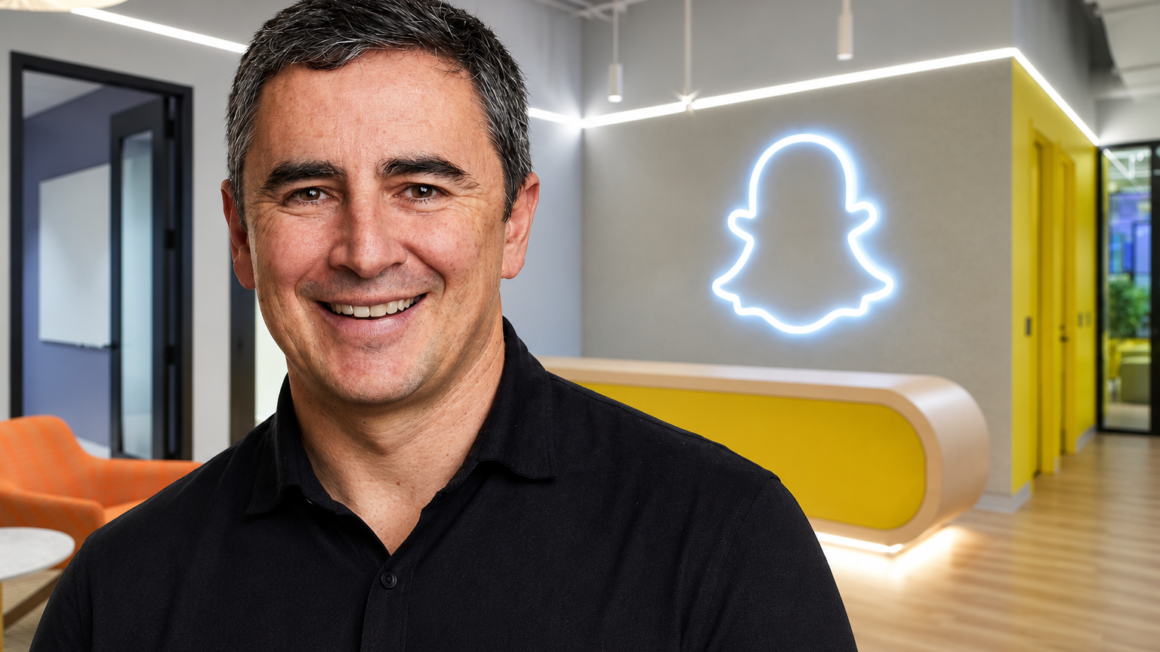
Snap is reshaping its commercial leadership as Chief Business Officer Ajit Mohan prepares to depart at the end of 2026, with EMEA President Ronan Harris taking charge of global advertising sales and go-to-market operations.
Snap has named Ronan Harris as its new Chief Commercial Officer, handing the longtime technology and advertising executive responsibility for the Snapchat parent company’s global advertising sales and go-to-market organization as Chief Business Officer Ajit Mohan prepares to leave the company.
Snap announced Harris’s appointment on September 8, marking a significant change at the top of the company’s commercial organization at a time when it is seeking to accelerate advertising growth and strengthen relationships with advertisers and agencies.
Mohan notified Snap on September 3 that he intends to leave the company to pursue other opportunities, according to a regulatory filing. His final day is expected to be December 31, 2026.
Snap said Mohan had confirmed that his decision was not connected to any disagreement with the company regarding its accounting, strategy, management, operations, policies or business practices.
The transition puts Harris, who has led Snap’s Europe, Middle East and Africa business for nearly four years, at the center of the company’s effort to translate its large global audience into stronger and more durable advertising revenue.
Ronan Harris takes charge of Snap’s global commercial organization
As Chief Commercial Officer, Harris will oversee Snap’s global advertising sales and go-to-market operations, with a mandate that includes growing advertising revenue and strengthening the company’s relationships with advertisers and agencies. He will report directly to Snap co-founder and Chief Executive Evan Spiegel.
Harris brings extensive digital advertising experience to the position.
Before joining Snap in 2022 as President of EMEA, he spent more than 17 years at Google, where he held a series of leadership positions and most recently served as Vice President and Managing Director for the UK and Ireland.
His performance running Snap’s European business provides an important indication of why the company has chosen an internal executive for the broader global role.
Snap said Europe delivered 10 consecutive quarters of double-digit year-over-year revenue growth through the second quarter of 2026 under Harris’s leadership. Revenue from the region grew nearly 40% during the first half of 2026.
That track record gives Harris a larger assignment: applying the commercial discipline and advertiser relationships developed in EMEA across Snap’s worldwide business.
The appointment also consolidates responsibility for advertising sales and market execution around an executive who has spent much of his career in the digital advertising industry.
Ajit Mohan helped rebuild Snap’s advertising organization
Mohan’s planned departure comes after almost four years at Snap.
He joined the company in January 2023 as President of Asia Pacific, having previously served as Vice President and Managing Director of Meta’s India business. Snap promoted him to Chief Business Officer in February 2025, expanding his responsibilities from APAC to the company’s global advertising business, revenue products and business operations.
Before Meta, Mohan was closely associated with the development of India’s digital media industry. He served as chief executive of Hotstar, the streaming platform originally developed by Star India before becoming part of Disney’s international streaming operations.
At Snap, Mohan arrived during a difficult period for the company’s advertising business.
Like several social and digital advertising platforms, Snap had been adapting to changes in mobile privacy, measurement and performance advertising while competing for marketing budgets against much larger platforms.
The company subsequently invested heavily in improving its advertising technology, machine-learning infrastructure, measurement tools and performance-marketing capabilities.
When Snap promoted Mohan to Chief Business Officer in 2025, the company said his role would include growing its advertising business across regions while bringing its revenue-product and business-operations organizations into closer alignment.
His departure therefore comes after a period in which Snap has substantially reworked the infrastructure supporting its advertising business.
Harris inherits Snap’s advertising business at a stronger moment
The leadership transition is taking place as Snap shows signs of improved financial momentum.
The company reported $1.60 billion in second-quarter 2026 revenue, up 19% year over year from approximately $1.34 billion a year earlier.
Snap also generated $176 million in operating cash flow and $121 million in free cash flow during the quarter, while its net loss narrowed to $164 million from $263 million a year earlier.
Snapchat reached 493 million daily active users in the second quarter and approximately 971 million monthly active users, giving the company one of the largest consumer audiences in global social media.
Yet scale alone does not determine the economics of a social platform.
For Snap, one of the central challenges remains turning that audience — particularly its strong position among younger users — into advertising revenue and cash generation at a level that can support continued investment in products including artificial intelligence and augmented reality.
That makes Harris’s assignment commercially significant.
Snap has been working to improve performance advertising, automate more of its advertising platform and give marketers better tools for measuring conversions and returns on spending. The company is simultaneously investing in new advertising formats incorporating artificial intelligence.
Earlier in 2026, for example, Snap introduced AI Sponsored Snaps, allowing brands to bring AI-powered conversational experiences directly into Snapchat.
The broader strategy increasingly connects advertising technology, artificial intelligence and Snap’s longer-term ambitions in augmented reality.
Commercial execution becomes more important as Snap invests in Specs
Harris also takes control of Snap’s commercial organization while the company continues investing in Specs, its augmented-reality glasses platform.
That creates a broader strategic relationship between the company’s established advertising operation and its longer-term technology bets.
Advertising remains fundamental to Snap’s ability to fund product development and build a more sustainable business. Spiegel has emphasized internally that faster advertising growth could strengthen the company and improve its ability to pursue its ambitions around Specs.
The organizational change therefore goes beyond replacing one senior executive with another.
Snap is placing an executive with more than two decades of experience in digital advertising and technology markets in charge of converting improvements in its advertising platform into global commercial growth.
Harris inherits a business showing considerably stronger revenue momentum than Snap experienced during some of the most difficult periods of its advertising overhaul. But he also takes the role in an intensely competitive market dominated by companies including Meta, Google and TikTok, all of which continue to invest aggressively in AI-driven advertising products.
His challenge will be to demonstrate that Snap can improve advertiser returns, deepen agency relationships and extract more economic value from a global Snapchat audience approaching one billion monthly users.
For Snap, that commercial execution will increasingly determine how much room the company has to pursue the next phase of its ambitions.
Mohan is expected to remain with the company through the end of December, giving Snap several months to complete the transition.
Harris, meanwhile, moves from overseeing one of Snap’s strongest-performing international regions to a global role in which the central question will be straightforward: whether the advertising growth achieved in markets such as Europe can be replicated at scale across the rest of Snap’s business.