
TFM EXCLUSIVE ANALYSIS
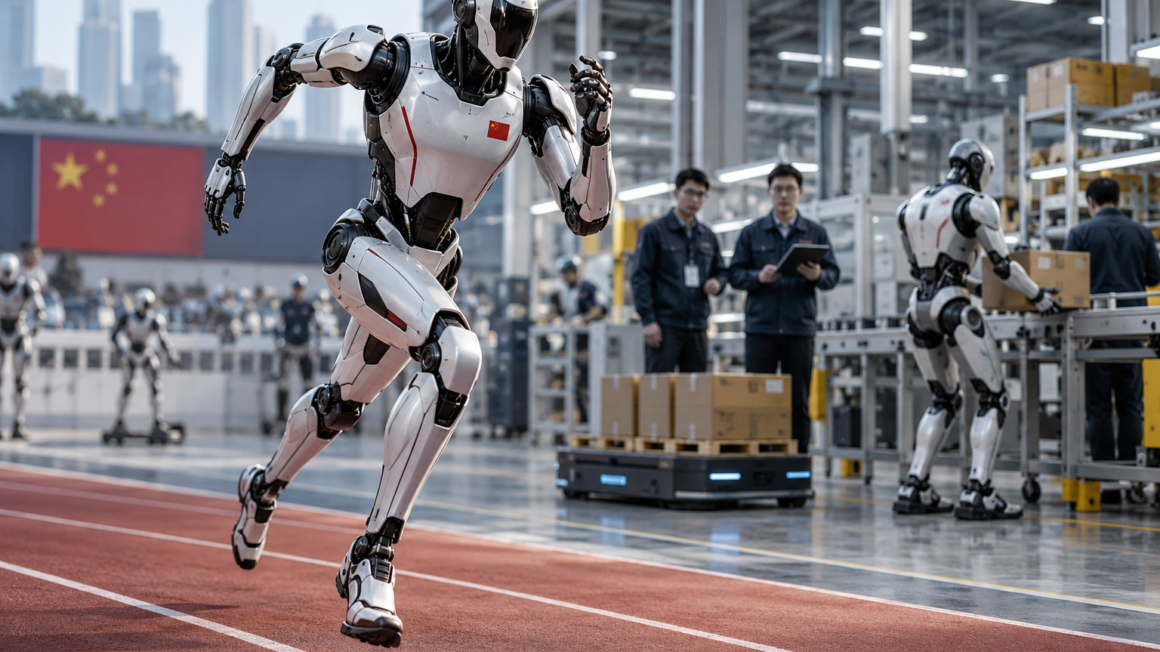
China’s TianGong Ultra completed 100 metres in 8.64 seconds—0.94 seconds quicker than Usain Bolt’s human world record. But The Founders’ analysis finds that the more consequential numbers lie outside the stadium: global humanoid shipments have nearly quadrupled, China dominates production, yet manufacturing and warehouse applications still account for only a minority of deployments. The next contest in humanoid robotics will not be measured in seconds. It will be measured in uptime, reliability, useful work and economic return.
BEIJING — A Chinese humanoid robot has done something that would have sounded improbable only a few years ago: complete 100 metres in less time than the fastest human being in recorded athletics history.
TianGong Ultra, developed by the Beijing Humanoid Robot Innovation Centre, also known as X-Humanoid, finished the 100-metre event at the World Humanoid Robot Games in 8.64 seconds.
Usain Bolt’s official 100-metre world record remains 9.58 seconds, set in Berlin on August 16, 2009, according to World Athletics.
The robot therefore completed the distance 0.94 seconds faster by elapsed time.
That does not mean TianGong Ultra has broken Bolt’s athletics world record—the robot was not competing under human athletics rules and the two performances are not directly comparable sporting records.
Technologically, however, the achievement is remarkable.
And commercially, it may be even more revealing for what comes next.
Jack Guo, the engineer leading development of TianGong Ultra and the smaller Omni humanoid at X-Humanoid, told Reuters that his team’s goal is now to transform extreme performance into reliability and usability.
That transition—from a machine capable of winning a race to one capable of doing economically useful work every day—is likely to determine whether the humanoid-robot industry becomes one of the next great industrial platforms or remains dominated by impressive demonstrations.
TFM Analysis: What 8.64 Seconds Actually Means
The headline comparison with Bolt becomes more useful when converted into motion data.
TianGong Ultra’s 8.64-second run implies an average speed across the 100 metres of approximately:
11.57 metres per second
or:
41.7 kilometres per hour
Bolt’s 9.58-second world-record performance corresponds to an average speed of approximately:
10.44 metres per second
or:
37.6 kilometres per hour
By elapsed time, Ultra completed the race approximately 9.8% faster.
But perhaps the more revealing number is how quickly the robot improved during the competition.
Ultra ran:
| Stage | TianGong Ultra 100m time |
|---|---|
| Preliminary | 9.39 seconds |
| Semifinal | 8.86 seconds |
| Final | 8.64 seconds |
From preliminary to final, its time improved by about 8%.
That progression happened as engineers changed running strategies, refined navigation and motion control, tested new programs and repaired machines damaged during extreme running trials. Reuters reported that the robot used three separately trained running strategies during the competition.
That may ultimately matter more than the Bolt comparison.
What X-Humanoid demonstrated was not simply mechanical speed.
It demonstrated the ability to train motion-control systems in simulation, transfer them into physical machines and rapidly improve performance through software and hardware iteration.
That feedback loop is one of the foundations of modern embodied artificial intelligence.
But Ultra Still Has a Problem: Stopping
There is an extraordinary contrast between the sophistication of TianGong Ultra’s acceleration and the relative immaturity of another basic human capability:
braking.
Ultra weighs about 75 kilograms and can exceed 17 metres per second at maximum speed, according to Reuters.
That translates to more than 61 kilometres per hour.
At the Robot Games, sprinting machines effectively used crash barriers and mats after crossing the line because stopping safely remained difficult.
Guo identified braking as one of the areas requiring improvement.
That detail cuts directly to the difference between competitive performance and commercial usefulness.
A robot in a factory, hotel, warehouse, hospital or public space cannot simply be fast.
It must be predictably safe.
A 75-kilogram autonomous machine moving rapidly around human workers needs reliable perception, braking, obstacle avoidance, force control and fail-safe systems.
Industrial customers are unlikely to care whether their robot can run 100 metres in 8.64 seconds.
They will care whether it can operate thousands of times without damaging a product, injuring a worker, falling over or requiring an engineer to intervene.
The Real Benchmark Is No Longer Speed
That is why the next humanoid-robot race will be measured using a very different scorecard.
For commercial buyers, the important metrics increasingly become:
uptime, intervention frequency, task-completion rate, cycle time, energy consumption, payload, safety, maintenance cost and total cost per completed task.
A spectacular robot that requires engineers to repair it after extreme operation has very different economics from a machine capable of performing repetitive work for an entire shift.
Reuters’ reporting from inside X-Humanoid illustrates that gap.
During the Robot Games, engineers sometimes worked through the night testing and repairing machines. Guo said earlier development failures included broken legs and damaged waists.
Those failures are understandable in a research environment where engineers intentionally push hardware beyond its established limits.
But they also demonstrate why successful commercialization requires more than raw capability.
The transition resembles what occurred historically in aviation, automobiles and industrial automation.
A prototype demonstrates that something can be done.
An industrial product proves that it can be done reliably, repeatedly, safely and economically.
Useful Work Has Already Started
X-Humanoid is beginning to move beyond demonstrations.
At a Foton Cummins engine factory in Beijing, its robots have been tested moving boxes.
The company’s Tianyi 2.0 humanoid has handled boxes weighing approximately 8 to 12 kilograms, moving them onto shelving in an early-stage industrial trial.
Its smaller Omni machine has demonstrated another form of mobility.
During an internal test this year, Omni climbed from the first to the 17th floor of X-Humanoid’s headquarters.
Guo expects smaller humanoids eventually to find applications in commercial services and light industrial environments.
Larger machines such as Ultra could be used for outdoor inspection and emergency rescue.
These applications are far less visually dramatic than beating Bolt’s time.
Commercially, they are far more important.
China Is Building More Than Fast Robots
X-Humanoid also sits inside an ecosystem that is difficult to understand by looking at individual robot demonstrations alone.
The organisation was established in November 2023 and is backed by state and private investors including humanoid-robot company UBTech and technology groups Xiaomi and Baidu.
It is based in Yizhuang, a technology and manufacturing hub in southeastern Beijing that has developed into one of China’s major robotics clusters.
China’s advantage is increasingly visible at the national level.
According to the International Federation of Robotics, China installed approximately 295,000 conventional industrial robots in 2024.
That represented 54% of all industrial robots installed worldwide that year.
China’s installed stock exceeded 2 million industrial robots, by far the world’s largest fleet.
Even more importantly for China’s robotics supply chain, domestic manufacturers captured 57% of their home market in 2024, up from 47% a year earlier and from roughly 28% over much of the previous decade.
The significance extends beyond today’s factory robots.
Motors, reducers, batteries, sensors, controllers, electronics, machining expertise and high-volume manufacturing capabilities developed for automotive, electronics and industrial automation can increasingly feed the humanoid supply chain.
This is one reason China’s robotics challenge to the rest of the world is not simply an AI contest.
It is also a manufacturing-system contest.
The Humanoid Numbers Are Beginning to Accelerate
The humanoid industry itself remains tiny compared with conventional industrial robotics.
But its growth rate has become difficult to ignore.
Counterpoint Research estimates that more than 22,000 humanoid robots were shipped worldwide during the first half of 2026.
That represented growth of nearly 300% year over year.
Counterpoint expects global shipments to exceed 50,000 units for the full year, although that figure remains a research forecast rather than an established outcome.
Chinese manufacturers dominate that emerging market.
AgiBot shipped approximately 9,700 humanoids in H1 2026, giving it more than 43% market share.
Unitree shipped more than 7,000, representing approximately 31%.
Together, those two Chinese manufacturers accounted for roughly three-quarters of reported worldwide shipments.
Galbot, UBTech and Leju Robotics followed.
Reuters separately reported that Chinese manufacturers accounted for about 95% of global humanoid shipments in 2025, underscoring just how geographically concentrated the emerging supply base has become.
TFM Data: The Commercialization Gap Is Still Huge
Shipment growth alone, however, can create a misleading impression about how close humanoids are to replacing conventional labour.
The application mix tells a much more nuanced story.
Counterpoint’s H1 2026 data show that entertainment and performance combined with data-production and research applications still accounted for more than 60% of global humanoid shipments.
By comparison:
Intelligent manufacturing accounted for approximately 13%.
Warehousing and logistics accounted for approximately 5%.
That means manufacturing and warehousing—the categories most directly associated with the popular vision of humanoids becoming general-purpose industrial workers—together represented only around 18% of shipments.
This is the number investors should watch.
A humanoid industry selling machines primarily for demonstrations, education, research, entertainment and data generation has fundamentally different economics from an industry deploying hundreds of thousands of machines into factories and logistics facilities.
The transition from one market to the other is now beginning.
It is not yet complete.
A $500 Million Market Trying to Become a Multi-Billion-Dollar Industry
Counterpoint estimates that global humanoid-robot sales revenue exceeded $500 million in 2025 for the first time.
AgiBot alone generated more than $140 million, while the world’s three leading suppliers—all Chinese—accounted for more than half of total sector revenue.
Counterpoint forecasts global humanoid revenue reaching approximately $4.4 billion in 2027.
That would represent enormous expansion in only two years.
But projections in an industry this young should be treated cautiously.
Humanoids still have to prove that customers outside research and demonstration markets will deploy machines in sufficient numbers to justify large-scale production.
The market therefore appears to be approaching an important threshold:
manufacturers have demonstrated that humanoids can increasingly be produced at scale; now they must prove that they can create scalable economic value.
Why China Wants Humanoids So Badly
Beijing’s push is not driven only by technological prestige.
It has an economic rationale.
China ended 2025 with a population of approximately 1.405 billion, down 3.39 million from the previous year.
The population aged 16 to 59 declined to approximately 851.36 million, from about 857.98 million in 2024—a reduction of roughly 6.6 million people in a single year.
Meanwhile, the number of people aged 60 and above increased to 323.38 million, equivalent to 23% of China’s population.
That demographic transition gives automation strategic importance.
China still has an enormous labour force. But over the long term, fewer working-age people supporting a larger older population creates pressure to raise productivity.
Robots capable of performing manufacturing, logistics, inspection, maintenance and service work could become one part of that productivity response.
Humanoids are particularly attractive because the physical world has already been designed around the human body.
Factories have stairs.
Warehouses have shelves.
Buildings have doors.
Tools have handles.
Human workstations have human proportions.
A machine approximating human morphology can theoretically operate within environments built for people without requiring every factory or facility to be redesigned around the robot.
That is the economic promise.
The difficulty is making the machine intelligent and reliable enough to exploit it.
Beijing Has Already Declared Humanoids Strategic
China’s Ministry of Industry and Information Technology laid out that ambition explicitly in its humanoid-robot development guidance.
The government targeted breakthroughs across what it described as the robot’s “brain,” “cerebellum” and “limbs,” covering artificial intelligence, perception, motion control and mechanical systems.
Its plan called for humanoid robots to reach advanced international levels and achieve batch production, followed by deeper integration into the real economy and larger-scale development by 2027.
That policy framework matters because China’s earlier success in electric vehicles, batteries, solar manufacturing and industrial robotics has demonstrated the power of combining national industrial priorities with local government support, manufacturing clusters, aggressive private competition and deep supply chains.
Humanoids are increasingly receiving similar treatment.
But government backing cannot eliminate the engineering problem.
Hardware Is Advancing Faster Than the Brain
The Robot Games highlighted one of the fundamental asymmetries in humanoid development.
Machines are becoming extremely good at highly trained physical behaviours.
Running is a strong example.
Through reinforcement learning and simulation, engineers can train motion policies that continuously adjust balance, joint position and force.
TianGong Ultra’s three running strategies demonstrate how sophisticated those systems have become.
But useful work is often harder than running.
A warehouse employee does not simply walk from A to B.
The worker recognizes unfamiliar objects, interprets instructions, responds to interruptions, grips objects with different surfaces, adjusts force, identifies damaged products, navigates around colleagues and resolves situations that were never explicitly programmed.
That requires perception, reasoning, dexterity and generalisation.
The physical machine is only half of the system.
The other half is physical AI.
And Guo acknowledges that building the AI capable of independently handling complex tasks will take longer than improving the robot body.
China’s Advantage—and Its Biggest Risk
China’s scale creates a potentially powerful feedback loop.
More robots mean more deployments.
More deployments create more real-world operational data.
More data can improve models.
Better models make robots more useful.
Greater usefulness generates more demand, which supports larger factories and lower component costs.
That is the optimistic scenario.
But there is also a risk of mistaking production volume for commercial maturity.
China’s regulators are already showing signs of concern about excessive financial enthusiasm around humanoid robotics.
Following Unitree Robotics’ highly volatile stock-market debut, Chinese regulators have reportedly begun applying greater scrutiny to humanoid-robot companies seeking public listings, including greater emphasis on recurring revenue, lower losses and meaningful technological innovation.
That is a significant development.
Capital markets are beginning to demand the same transition that engineers like Guo are pursuing:
from demonstrations to economics.
The Founders’ Commercialization Test
For investors and industrial customers, The Founders believes humanoid progress should increasingly be judged against five questions.
First: Can the robot perform a genuinely valuable task?
Carrying a box in a controlled demonstration is different from managing continuous material movement inside an operating factory.
Second: How often does a human need to intervene?
A machine operating autonomously 99% of the time can still become uneconomic if the remaining 1% requires highly paid engineers to continually rescue it.
Third: Can it survive industrial duty cycles?
Factories value reliability more than spectacle.
Fourth: Does the total cost beat the alternative?
The appropriate comparison may not always be a human worker. A fixed robotic arm, conveyor, autonomous mobile robot or redesigned production process can often accomplish the same task more cheaply.
Humanoids need to win where their flexibility provides enough value to offset their mechanical complexity.
And fifth: Can the system generalise?
The ultimate economic breakthrough will arrive when the same robot can learn multiple tasks rather than requiring extensive engineering for every new deployment.
That is when humanoids could begin behaving less like specialised industrial machinery and more like a general-purpose labour platform.
The 8.64-Second Run Matters—Just Not for the Obvious Reason
TianGong Ultra’s victory is therefore more meaningful than a novelty race between machine and human performance.
The robot’s 8.64-second sprint provides evidence that humanoid locomotion is moving extraordinarily quickly.
Its approximately 8% improvement during a single competition shows how rapidly trained control systems can be refined.
Its speed demonstrates what modern actuators, control algorithms, simulation and mechanical engineering can achieve when optimised around one objective.
But the crashes, repairs and braking challenges reveal the other half of the story.
The machine that wins the technological race may not be the one that ultimately wins the commercial market.
The winner may instead be the robot that moves somewhat slower but can work every day, understand new tasks, interact safely with people and produce a measurable financial return.
TFM Conclusion
China has already established an extraordinary position in robotics.
It accounted for 54% of global industrial-robot installations in 2024.
Chinese manufacturers dominated global humanoid shipments in 2025.
Global humanoid shipments exceeded 22,000 units during the first half of 2026, nearly four times the year-earlier level.
And now a Chinese humanoid has completed 100 metres in 8.64 seconds, faster by elapsed time than the 9.58 seconds achieved by the fastest human sprinter in history.
Those facts establish technological momentum.
But The Founders’ analysis identifies the metric that may matter more.
Only around 13% of H1 2026 humanoid shipments went into intelligent manufacturing and another 5% into warehousing and logistics, while entertainment, performance, data production and research still dominated the market.
That is the commercialization gap the industry must now close.
The next milestone will not be another robot shaving a fraction of a second off a sprint.
It will be thousands of machines walking into factories, warehouses, commercial buildings and hazardous environments—and continuing to work after the cameras leave.
TianGong Ultra has already shown that a robot can outrun Bolt’s time.
Now China must prove that its robots can earn a place on the payroll.
TFM Research Note: Calculations attributed to The Founders are derived from publicly reported race results, World Athletics records, International Federation of Robotics data, Counterpoint Research estimates and official Chinese population statistics. Market forecasts are third-party estimates and should not be interpreted as guaranteed outcomes.