Exclusive Analysis | September 13, 2026
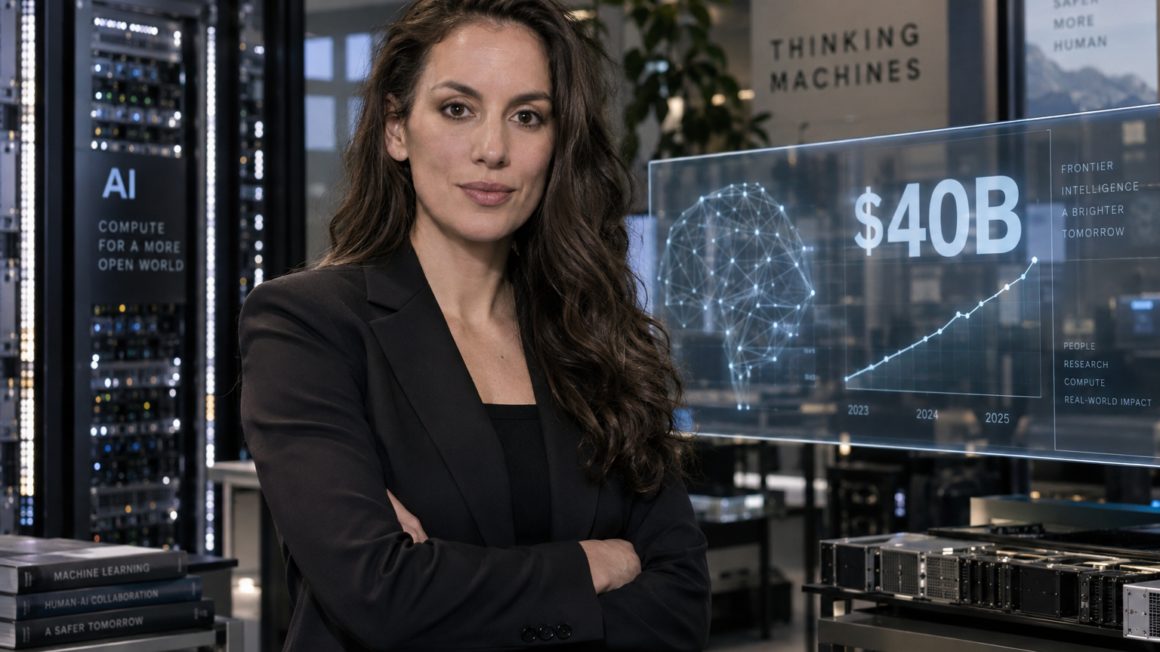
The former OpenAI CTO’s young AI company is discussing a multibillion-dollar financing at a valuation of at least $40 billion. The number is extraordinary—but the more important story is what investors would actually be paying for: scarce AI talent, enormous computing capacity, an open-weight model strategy and a chance to own part of the infrastructure layer beneath enterprise AI.
Thinking Machines Lab, the artificial-intelligence startup founded by former OpenAI chief technology officer Mira Murati, is back in the capital markets with one of the most aggressive valuation propositions in Silicon Valley.
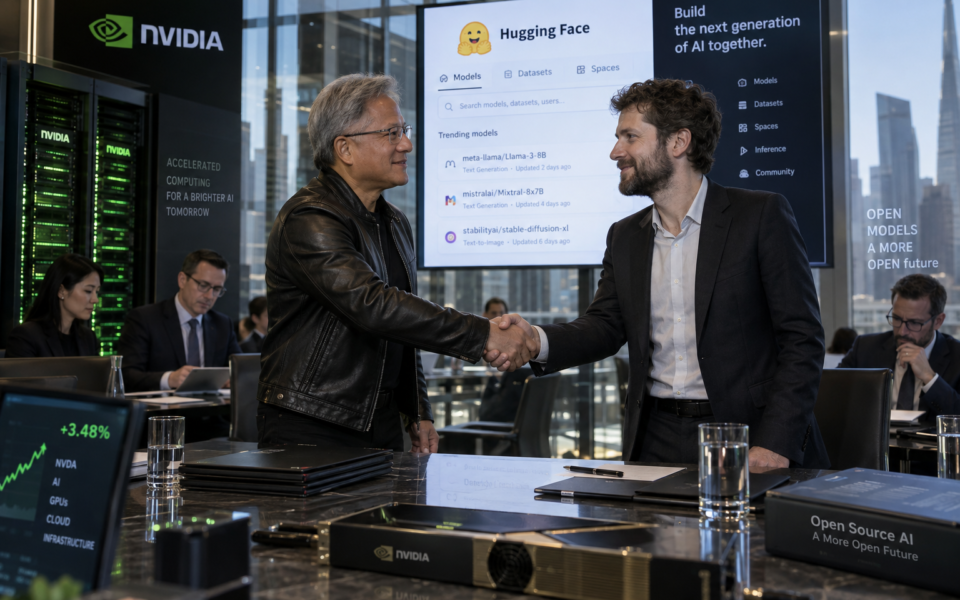
The company is in discussions to raise between $5 billion and $6 billion at a pre-money valuation of at least $40 billion, according to The Information’s latest reporting. Venture firm Accel is in talks to lead the financing, while Nvidia is expected to contribute roughly half of the capital, or around $2.5 billion, according to the report.
The financing is not completed, and its terms could still change. That distinction matters. Earlier summaries of the fundraising discussions cited a round of about $1 billion at a valuation of at least $40 billion; subsequent reporting put the contemplated raise at $5 billion to $6 billion. TechCrunch also reported that Accel and Thinking Machines had not responded to requests for comment on the talks.
So the most defensible description today is not that Thinking Machines has raised money at a $40 billion valuation. It is that the company is in talks to do so.
That caveat does little, however, to diminish the significance of the number.
A $40 billion pre-money valuation would make Thinking Machines one of the most valuable young artificial-intelligence companies in the world—and would put a company founded only in 2025 in the same broad valuation conversation as technology businesses that have spent years building customers, revenue and distribution.
The question for investors is therefore larger than whether Murati can raise another giant round.
It is whether the economics of frontier AI have changed so profoundly that a startup can rationally be worth tens of billions of dollars before its commercial scale remotely resembles that valuation.
From $2 Billion Seed Round to a $40 Billion Price Tag
Thinking Machines emerged publicly in early 2025 with an unusually powerful advantage: its founder.
Murati had spent more than six years at OpenAI and served as its CTO during the period in which products including ChatGPT helped turn generative AI from a research field into a global technology market. When she assembled Thinking Machines, investors were effectively being offered access to a team with experience inside one of the organizations that had defined the modern AI era.
That reputation translated into capital quickly.
In July 2025, Thinking Machines closed a $2 billion seed financing led by Andreessen Horowitz. A company spokesperson told TechCrunch that the transaction valued the startup at $12 billion. Reporting around the deal had previously described a roughly $10 billion pre-investment valuation, meaning the $12 billion figure is consistent with a $10 billion pre-money valuation plus the $2 billion investment. Nvidia, Accel and other strategic and financial investors participated.
The new talks therefore imply a striking repricing.
At $40 billion pre-money, Thinking Machines would be valued at roughly four times the pre-money valuation attached to its 2025 seed round.
But unlike during its first financing, Murati is no longer selling investors only a team, a mission and the promise of future research.
Thinking Machines now has products, a foundation model, reported revenue and—perhaps most consequentially—access to computing infrastructure on a scale normally associated with the largest AI laboratories.
That is the case investors are being asked to underwrite.
The Company Is Beginning to Reveal What It Actually Wants to Be
The most useful way to understand Thinking Machines is not as another company trying to build a better chatbot.
Its strategy increasingly appears to revolve around customizable intelligence.
In October 2025, Thinking Machines introduced Tinker, a managed API for fine-tuning open-weight language models. Customers control their training data and algorithms while Thinking Machines handles the underlying complexity of distributed training, scheduling, resource allocation and infrastructure failures.
That may sound technical, but commercially it addresses a fundamental problem.
The largest AI companies have spent years building general-purpose models intended to serve hundreds of millions of users. Enterprises, by contrast, increasingly want AI systems that understand their own workflows, proprietary information and specialized expertise.
A bank may want a model trained around financial judgment. A pharmaceutical company may need a system adapted to scientific research. A software company may want one optimized around its code base, tools and engineering practices.
Thinking Machines is betting that the next stage of enterprise AI will not be dominated exclusively by one universal model.
It will include organizations shaping models around themselves.
That philosophy became more visible in July with the launch of Inkling, Thinking Machines’ first internally trained open-weight foundation model.
The company says Inkling is a mixture-of-experts model with 975 billion total parameters and 41 billion active parameters, trained on 45 trillion tokens spanning text, images, audio and video. It supports a context window of up to one million tokens. Reuters also described Inkling as an open-weight model that customers can download, run and customize.
Perhaps the most revealing detail was what Thinking Machines did not claim.
In its own technical announcement, the company explicitly acknowledged that Inkling is not the strongest model overall, whether measured against open or closed competitors. Its argument instead is that the combination of multimodal capability, efficiency and customizability makes Inkling a useful base model for organizations that want to build something more specialized.
That distinction is central to Murati’s strategy.
Thinking Machines does not necessarily need to win every intelligence benchmark to build a major business.
It needs to become valuable at the point where sophisticated organizations turn general-purpose models into proprietary AI systems.
The $40 Billion Valuation Cannot Be Explained by Revenue
Traditional financial analysis becomes uncomfortable here.
TechCrunch reported in early September that Thinking Machines had an annual revenue run rate above $100 million, citing a person familiar with the company’s financials. The Information’s later reporting characterized the startup as generating hundreds of millions of dollars in annualized revenue. Neither figure should be confused with audited annual revenue publicly disclosed by the company. Thinking Machines is privately held, and it has not published financial statements establishing those numbers.
That attribution is important because “annualized revenue” or “run-rate revenue” can be particularly slippery in artificial intelligence.
A run rate typically extrapolates a recent period of sales rather than representing revenue actually earned over a complete year. AI companies may also have highly variable consumption-based revenue, unlike traditional subscription-software companies with predictable recurring contracts.
Whatever precise revenue figure investors are using, $40 billion cannot be justified by conventional current-revenue multiples alone.
That does not automatically make the valuation irrational.
It means investors would be paying primarily for future market position rather than present cash generation.
They would be valuing Thinking Machines more like an emerging technology platform than an ordinary software company.
And that requires an entirely different thesis.
Nvidia Changes the Investment Case
The strongest argument for Thinking Machines being valued like a future platform may be found outside its software.
It lies in its relationship with Nvidia.
In March 2026, Thinking Machines and Nvidia announced a multiyear strategic partnership under which the startup intends to deploy at least one gigawatt of Nvidia Vera Rubin systems, with deployment targeted to begin in early 2027.
Nvidia also made what the companies described as a significant investment in Thinking Machines, although they did not disclose its size.
A gigawatt-scale commitment is not the profile of a normal startup infrastructure contract.
It signals an intention to operate at frontier scale.
Modern foundation-model development is increasingly an industrial business. The principal inputs are no longer simply engineers and venture capital. They include GPUs, networking equipment, data centers, electricity, cooling infrastructure and long-term access to enormous quantities of computing capacity.
That changes competitive dynamics.
A research team can possess exceptional ideas but still struggle to compete if it cannot obtain enough compute. Conversely, a company with guaranteed access to cutting-edge hardware has the ability to conduct experiments and train models that would be impossible for smaller laboratories.
Thinking Machines’ Nvidia relationship therefore gives investors something tangible behind the valuation story: a route to frontier-scale infrastructure.
It also introduces risk.
Nvidia is not merely a supplier. It is already an investor in Thinking Machines and, according to current fundraising reports, could become an even larger financial backer. Reuters has noted the broader phenomenon of Nvidia investing across the AI ecosystem while the companies receiving that capital are themselves major purchasers of Nvidia hardware.
That does not invalidate the economics. But investors need to distinguish between two things: capital that helps finance extraordinary infrastructure expansion and independent customer demand capable of producing durable returns on that infrastructure.
A one-gigawatt compute strategy is impressive.
It is also expensive.
The ultimate question is not how many GPUs Thinking Machines can obtain. It is whether customers will generate enough economic value through those GPUs to justify them.
The Real Asset Investors Are Pricing Is Scarcity
The $40 billion proposal makes more sense when Thinking Machines is viewed as a collection of scarce assets rather than a conventional startup.
The first scarce asset is talent.
The second is compute.
The third is credible foundation-model capability.
And the fourth is the opportunity to build a new layer of enterprise infrastructure around model customization.
Very few new companies possess all four simultaneously.
That is why AI investors increasingly appear willing to finance leading researchers before the businesses surrounding them are mature.
In previous generations of venture capital, founders normally had to demonstrate product-market fit before commanding enormous valuations.
Frontier AI has inverted parts of that sequence.
Investors now know that assembling an elite research organization and securing sufficient computing infrastructure can itself require billions of dollars. By the time traditional financial proof arrives, the most important teams and infrastructure contracts may already belong to competitors.
Venture firms are therefore attempting to identify potential category leaders earlier—and finance them heavily enough to survive the race.
Thinking Machines is one of the clearest examples of that new model.
But Talent Is Also a Valuation Risk
A company valued partly because of its people becomes vulnerable when those people leave.
Thinking Machines has experienced a number of high-profile departures since its formation. The movement of researchers among OpenAI, Thinking Machines and other leading laboratories has underlined how fluid the market for elite AI talent has become. TechCrunch noted several departures while reporting the current fundraising discussions. Reuters had also cited key departures when covering the company’s Nvidia partnership earlier this year.
This is more than an HR issue.
It is a financial issue.
The fundamental question is whether Thinking Machines has already converted its early concentration of talent into assets that survive individuals: proprietary research, training infrastructure, customer relationships, models, data, engineering systems and an institutional culture capable of continuously recruiting exceptional researchers.
That conversion—from a collection of famous résumés into a durable institution—is one of the most important transitions any founder-led deep-technology company must make.
At a $40 billion valuation, investors would be assuming that Thinking Machines is already well along that path.
Open Models Give Murati a Different Route to Scale
Thinking Machines’ open-weight strategy also deserves more attention than the headline valuation.
Open-weight AI has become one of the major strategic battlegrounds in the industry. It allows developers and enterprises to operate and modify models rather than relying entirely on an API controlled by a model provider.
Reuters noted when Inkling launched that open-weight models have become particularly important as organizations look for customizable alternatives to proprietary systems from major U.S. AI companies.
Thinking Machines appears to be trying to combine the openness of downloadable models with a commercial infrastructure business.
That can look contradictory at first.
If companies can obtain model weights, why pay Thinking Machines?
Because possessing a model and successfully adapting it are very different things.
Training, reinforcement learning, evaluation and large-scale fine-tuning remain technically difficult and computationally expensive. Tinker is designed to monetize that complexity.
In other words, Thinking Machines can give away—or openly release—an important layer of intellectual property while charging customers for the infrastructure and expertise required to transform that technology into something commercially useful.
The analogy is closer to open-source enterprise infrastructure than conventional proprietary SaaS.
If it works, openness is not a threat to the business model.
It is the distribution strategy.
$40 Billion Also Reflects the New Economics of the AI Race
Thinking Machines’ proposed valuation looks extreme in isolation.
It becomes more understandable when placed beside the extraordinary amount of capital being deployed across AI.
Mistral, for example, recently raised €3 billion at a valuation of approximately €21 billion, or $24 billion, according to Reuters. The French foundation-model company expects annual recurring revenue to reach roughly $1 billion by the end of the year.
Elsewhere in AI, Cognition announced a $2 billion financing at a $48 billion valuation in September, illustrating the enormous prices investors are willing to assign to rapidly growing AI businesses.
The comparison is not perfect: the companies have different products, revenue bases and market strategies.
But the direction is unmistakable.
AI capital formation is operating at a scale that would have been exceptional even for late-stage technology companies only a few years ago.
The reason is straightforward. Investors believe the winners of the foundation-model and AI-platform era could eventually become some of the world’s most consequential technology companies.
The result is a market in which investors are willing to pay today for economic dominance that may not materialize for years.
What Has to Go Right
The difficult part begins after the financing.
Thinking Machines must prove that Tinker can become a significant commercial platform rather than a highly specialized product for AI researchers. It has to show that Inkling and subsequent models can remain relevant as competitors release new generations at extraordinary speed.
It must convert massive computing commitments into economically productive customer workloads.
It must maintain a world-class research organization despite aggressive recruiting from better-capitalized competitors.
And it must demonstrate that customization is a large enough market to support a company valued in the tens of billions of dollars.
There is also a strategic question.
The largest AI laboratories can increasingly offer customization, fine-tuning, agents and enterprise-specific services of their own. Thinking Machines is therefore betting not only that organizations want customized AI, but that enough of them will prefer a platform designed around customization rather than receiving those capabilities from incumbent model providers.
That is a serious competitive challenge.
It is also precisely why the company’s open-weight position matters.
Murati is attempting to make Thinking Machines structurally different rather than merely smaller.
The Founders Magazine Analysis
The $40 billion headline risks obscuring the most important point.
Thinking Machines is not being valued on what it is today.
It is being valued on what investors believe it might control tomorrow.
The investment thesis is that advanced AI becomes an infrastructure layer across the economy; that enterprises increasingly require models shaped around proprietary expertise; that open-weight systems remain strategically important; and that the combination of elite researchers, large-scale compute and a customization platform can create a durable position between raw foundation models and enterprise applications.
If those assumptions are correct, a company sitting at that intersection could be enormously valuable.
But $40 billion leaves relatively little room for ordinary success.
At that valuation, Thinking Machines cannot merely build excellent technology. It needs to become a major platform.
That is the defining tension around Mira Murati’s latest fundraising effort.
Her reputation helped Thinking Machines raise one of the largest seed rounds Silicon Valley had seen. Product launches have since given the company evidence of execution. Nvidia has given it a path toward enormous compute capacity. Inkling and Tinker have made its strategic direction increasingly visible.
Now investors are being asked to price the next stage before it has fully arrived.
The outcome will matter beyond one startup.
Thinking Machines is becoming a test of a much broader proposition at the heart of today’s AI boom: how much should investors pay for the possibility of owning a foundational layer of the next computing era before conventional financial metrics can prove its value?
At a $40 billion valuation, Mira Murati is asking the market to answer that question early.
And with billions potentially on the table, the answer could help set the price of the next generation of AI laboratories.
Editorial disclosure: This article provides independent analysis by The Founders Magazine and should not be read as confirmation that the pending financing has closed.