The reported anchor investment could put Nvidia at the center of what may become the largest IPO in history—and reveal how tightly capital, computing power and frontier AI are becoming intertwined.
By The Founders Magazine | Exclusive Analysis
Nvidia may be preparing to make one of its most consequential AI investments yet.
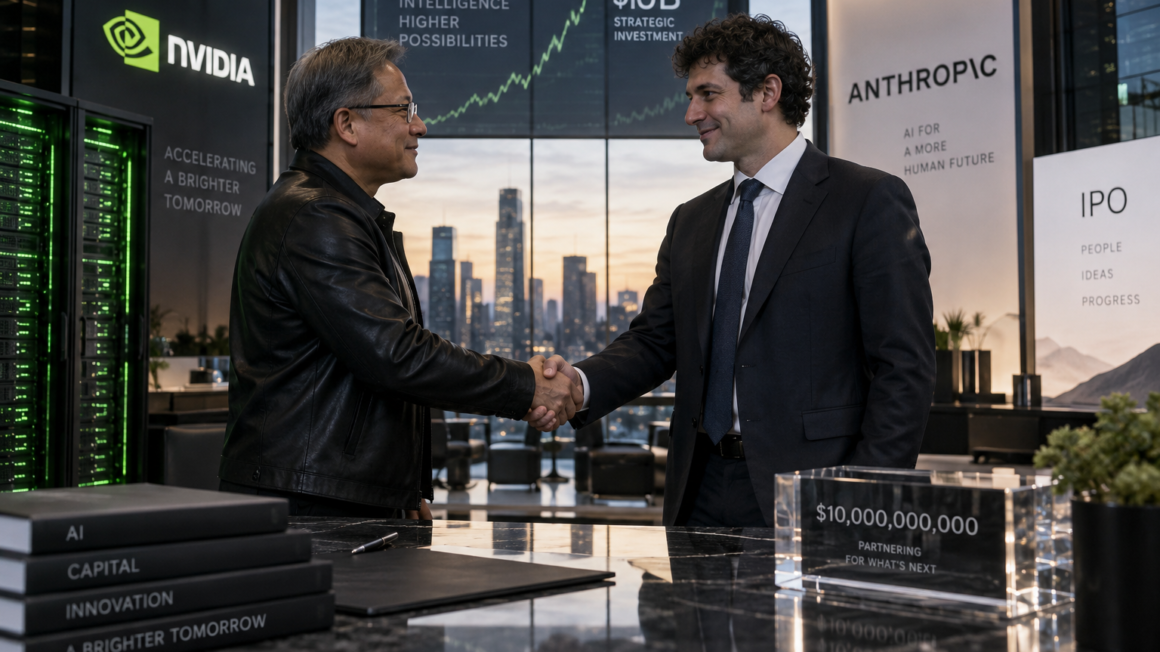
The semiconductor giant is in discussions to become an anchor investor in Anthropic’s anticipated initial public offering, with Nvidia considering an investment of as much as $10 billion, according to Reuters, citing people familiar with the talks. Anthropic, the company behind the Claude family of AI models, is reportedly exploring an offering that could raise as much as $100 billion and value the company at approximately $2 trillion. The transaction has not been finalized, the terms could change, and neither Nvidia nor Anthropic has publicly confirmed the IPO investment.
If those numbers hold, this would be far more than another Silicon Valley funding round.
It could become one of the defining transactions of the artificial-intelligence era: the dominant supplier of AI computing infrastructure potentially putting billions directly into one of the companies consuming that infrastructure at extraordinary scale.
For founders and investors, the bigger story is not simply the size of Nvidia’s prospective cheque. It is the emerging structure of the AI economy itself.
From Chip Supplier to Capital Provider
Nvidia’s relationship with Anthropic already extends well beyond selling GPUs.
In November 2025, Nvidia and Microsoft announced strategic partnerships with Anthropic. Anthropic committed to purchase $30 billion of Microsoft Azure compute capacity, with deployments powered in part by Nvidia systems, while Nvidia said it planned to invest up to $10 billion in Anthropic and Microsoft committed up to $5 billion. Nvidia and Anthropic also agreed to collaborate on optimizing future Anthropic models for Nvidia architectures and Nvidia systems for Anthropic workloads.
That history creates an important qualification around the latest headline.
The $10 billion figure itself is not completely new: Nvidia had already announced an intention to invest up to that amount in Anthropic in 2025. What is newly reported is the possibility of Nvidia becoming an anchor investor in Anthropic’s IPO. Reuters has not established publicly whether the potential IPO purchase would fulfill the earlier commitment, restructure it, or represent capital in addition to it.
That distinction matters.
An ordinary strategic investment aligns two companies privately. An anchor investment in a gigantic IPO does something more: it can send a confidence signal to institutional investors preparing to value the company in public markets.
For Anthropic, having Nvidia near the front of the order book would effectively place one of the AI industry’s most influential infrastructure companies behind the offering.
For Nvidia, the rationale may be even more strategic.
If Anthropic continues expanding, it will require immense quantities of computing infrastructure. Nvidia can potentially benefit twice: first through the appreciation of an equity investment, and second through demand for the computing systems required to train and operate Claude.
The Numbers Behind Anthropic’s Extraordinary Rise
Anthropic’s growth explains why investors are even discussing numbers that would have seemed implausible for a five-year-old company only a short time ago.
In May 2026, Anthropic raised $65 billion at a $965 billion post-money valuation, more than doubling the $380 billion valuation it had received earlier in the year. Reuters reported that its annualized revenue run rate had reached approximately $47 billion at the time.
By the end of July, Anthropic’s annualized revenue run rate had reportedly climbed beyond $65 billion, compared with roughly $9 billion at the end of 2025. The company has also been projecting approximately $190 billion to $200 billion of revenue in 2028, according to Reuters reporting on information being presented to investors.
Those numbers explain both the excitement and the risk surrounding a potential $2 trillion valuation.
At a $65 billion annualized revenue run rate, a $2 trillion valuation represents roughly 31 times current run-rate revenue.
Against management’s reported $190 billion-to-$200 billion 2028 revenue projection, however, the valuation would represent closer to 10 times projected 2028 sales.
The investment case therefore depends heavily on one assumption: Anthropic must keep growing at a pace that would be exceptional even by the standards of history’s fastest-growing technology businesses.
Public-market investors would not merely be buying Claude’s current momentum. They would be buying several years of extraordinary future growth in advance.
Why Nvidia Wants a Seat at the Table
There are at least three strategic reasons Nvidia could find an Anthropic investment attractive.
The first is straightforward: AI model companies are Nvidia’s customers.
Anthropic requires enormous computing capacity to train frontier models and serve enterprise customers. Nvidia therefore has a direct economic interest in the expansion of companies capable of converting GPUs into commercially valuable AI services.
The second is competitive positioning.
Anthropic does not rely exclusively on Nvidia. It has deliberately constructed a diversified infrastructure strategy using Nvidia GPUs, Amazon’s Trainium processors and Google’s TPUs. Amazon remains Anthropic’s primary cloud and training partner, while Anthropic has also expanded arrangements with Google and Broadcom.
Amazon’s relationship alone is enormous. In April 2026, Anthropic announced plans to commit more than $100 billion to AWS technologies over ten years, securing up to five gigawatts of additional computing capacity. Amazon simultaneously announced another $5 billion investment in Anthropic, with the possibility of investing as much as $20 billion more.
That means Nvidia is competing not simply to sell accelerators, but to remain embedded in Anthropic’s long-term computing architecture while cloud providers and chip designers increasingly build their own silicon.
An equity relationship can reinforce that position.
The third reason is strategic optionality.
If frontier AI eventually produces several companies worth trillions of dollars, owning equity in those companies gives Nvidia exposure to value created above the hardware layer.
Nvidia would no longer participate only when a customer buys a GPU. It could participate in the enterprise value created by the software and models running on those GPUs.
That represents an important evolution in Nvidia’s role: from arms dealer in the AI race to financier of the combatants themselves.
The Circular-Financing Question
That strategy is powerful, but it also introduces a question investors are increasingly asking across the AI industry.
What happens when the company selling the infrastructure also finances the companies buying the infrastructure?
Nvidia has already faced scrutiny over investments in AI companies and infrastructure providers that are also major users of its chips. Reuters reported earlier this year that investors have raised concerns about potential “circular financing” as Nvidia commits capital to companies participating in the same AI ecosystem from which it generates substantial demand.
The concern does not automatically make the investments unsound.
Strategic vendor financing has existed in technology, telecommunications, aircraft manufacturing and other capital-intensive industries for decades. Nvidia may ultimately earn substantial returns by helping accelerate companies that expand the market for accelerated computing.
But investors must distinguish between organic demand and demand partly enabled by capital supplied by the vendor itself.
An Nvidia–Anthropic IPO relationship would therefore deserve scrutiny from both sides.
Anthropic investors will want to know how much of its computing expenditure is required to sustain revenue growth and what margins eventually emerge after infrastructure costs.
Nvidia investors will want to understand how much capital is being deployed to customers, what financial returns those investments generate, and whether those relationships materially influence hardware demand.
The deeper the financial links become, the more important transparency becomes.
Anthropic Is Building an Infrastructure Hedge
There is another reason the Nvidia investment should not be interpreted as Anthropic surrendering its computing strategy to a single supplier.
Anthropic has aggressively diversified.
The company says Claude is trained and operated across AWS Trainium, Google TPUs and Nvidia GPUs. It has agreements covering vast amounts of future capacity from Amazon, Google, Broadcom, Microsoft, Nvidia and others.
Reuters also reports that Anthropic is building an internal team focused on custom chip development as it seeks greater control over hardware economics.
For a frontier AI company, this is strategically important.
Compute is not simply an operating expense. It is one of the primary constraints on growth.
Whoever controls access to chips, electricity, data centers and networking increasingly influences how quickly AI companies can train new models, expand inference capacity and serve customers.
Anthropic appears to be treating infrastructure diversification almost like a geopolitical strategy: avoid dependence on any single supplier while maintaining relationships with all the major powers.
A $2 Trillion Test for Wall Street
Anthropic’s IPO would also test something larger than the company’s valuation.
It would test whether public markets are prepared to finance the frontier-model business at the same extraordinary valuations private investors have been willing to accept.
Reuters reports that U.S. IPOs excluding SPACs had already raised a record $137 billion through August 2026. Anthropic’s offering, potentially reaching $100 billion by itself, could dramatically raise that figure.
But AI companies come with an unusual financial profile.
Revenue can grow extraordinarily quickly, yet the capital required to maintain technological leadership is also immense. Training larger models, serving billions of inference requests, acquiring data-center capacity and attracting elite technical talent can consume tens of billions of dollars.
The market therefore faces a question familiar from previous technological revolutions but operating at unprecedented scale:
How much should investors pay today for infrastructure-intensive growth whose economics may not fully mature for years?
Anthropic’s answer appears to be that scale, enterprise adoption and technological leadership will eventually produce economics capable of supporting a multi-trillion-dollar company.
The IPO would force public investors to decide whether they agree.
Safety Meets Shareholder Pressure
There is another tension that may become increasingly important once Anthropic enters public markets.
Anthropic was founded with AI safety as a central part of its identity. CEO Dario Amodei has continued warning about the potential risks of increasingly capable AI systems and recently called for stronger mechanisms to evaluate and coordinate frontier-model development.
Yet a public company valued near $2 trillion would also operate under intense pressure to maintain revenue growth, deliver returns and justify enormous capital investments.
Those forces are not necessarily incompatible. Safer systems can become more trusted systems, particularly among governments and enterprises.
But the tension is real.
The more investors pay for future growth, the stronger the financial incentive to keep expanding the technology that creates that growth.
Anthropic may therefore become an important experiment in whether a frontier AI company can simultaneously satisfy three groups with very different expectations: researchers demanding caution, customers demanding increasingly capable models, and shareholders demanding financial performance.
What the Deal Means for Founders
For entrepreneurs, the prospective Nvidia investment offers a preview of how the technology industry may evolve.
The next generation of dominant companies may not be built through traditional venture capital alone.
At the frontier of AI, strategic suppliers, cloud providers, semiconductor manufacturers, sovereign funds and infrastructure financiers are increasingly becoming part of the capital stack.
That changes startup strategy.
For founders building capital-intensive AI companies, securing distribution or customers may no longer be enough. The ability to secure compute, energy, financing and strategic infrastructure partnerships can become as important as software execution.
Anthropic illustrates the model vividly.
It is simultaneously a customer of Nvidia, Amazon, Google and Microsoft; a technology partner to several of them; an investment asset for some of them; and, in certain areas, a potential long-term threat to their own AI businesses.
The old boundaries between supplier, investor, partner and competitor are disappearing.
The Bigger Bet
If Nvidia ultimately invests $10 billion at a $2 trillion valuation, it would acquire only about 0.5% of Anthropic, ignoring any special terms or dilution.
Financially, that may look small relative to Anthropic’s enormous proposed valuation.
Strategically, however, the symbolism could be enormous.
Nvidia would be signalling that its ambitions extend beyond dominating the semiconductor layer. It wants exposure to the companies that could dominate the intelligence layer built above its hardware.
Anthropic, meanwhile, would gain something arguably more important than another large cheque: validation from the company that has become one of the foundational suppliers of the AI revolution.
The deal is still only under discussion.
The IPO terms can change. The valuation can change. The size of Nvidia’s investment can change. And the offering itself will ultimately have to survive the judgment of public-market investors.
But the direction of travel is becoming increasingly clear.
The AI industry is evolving from a collection of technology companies into an interconnected financial and industrial system—one in which chip companies fund model developers, model developers commit billions to cloud providers, cloud providers design chips, and nearly everyone is simultaneously somebody else’s customer, partner, investor or competitor.
A $10 billion Nvidia bet on Anthropic would not create that system.
It would simply make it impossible to ignore.