
TFM EXCLUSIVE ANALYSIS
An SBI-led lender group is reportedly preparing about $3.5 billion in debt financing for Vodafone Idea, potentially removing one of the biggest obstacles to the telecom operator’s attempt to rebuild its network and restore competitiveness against Reliance Jio and Bharti Airtel. But The Founders’ analysis suggests the financing should be viewed as the beginning of Vi’s execution test—not the completion of its turnaround.
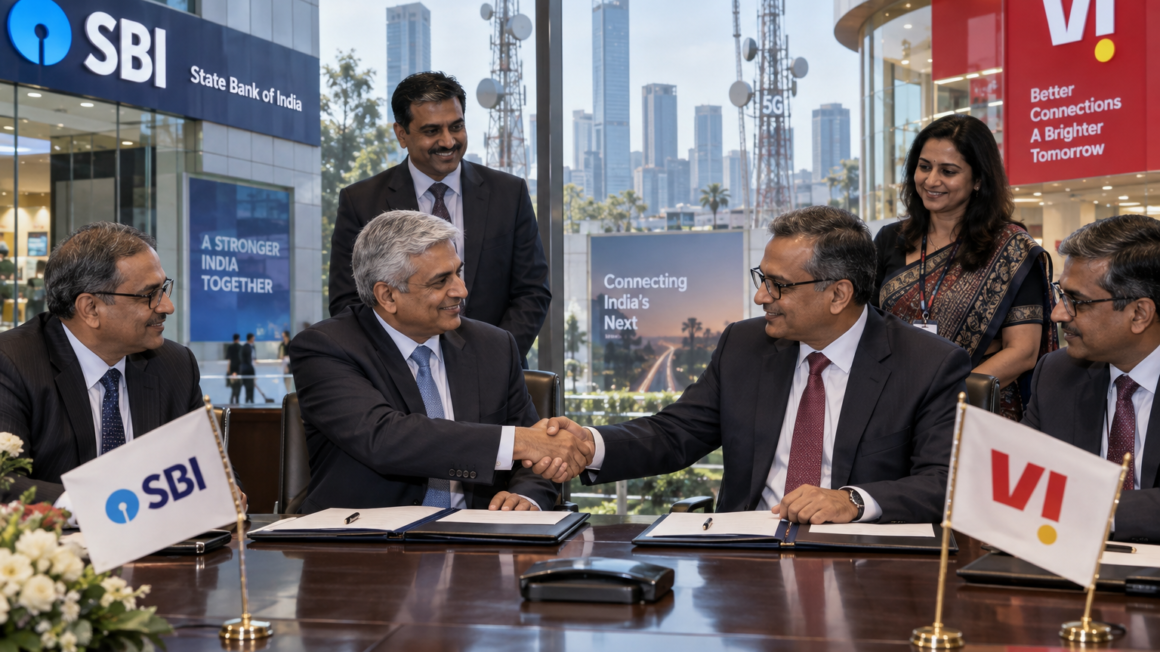
An Indian lender consortium led by State Bank of India is said to have agreed to provide approximately $3.5 billion in debt financing to Vodafone Idea, giving the country’s third-largest private telecom operator access to capital it has spent months seeking for its network expansion programme.
The consortium includes State Bank of India, Union Bank of India and the National Bank for Financing Infrastructure and Development, according to people familiar with the discussions cited by Bloomberg. The financing is expected to help Vodafone Idea strengthen its mobile network and compete more effectively against substantially larger rivals Reliance Jio and Bharti Airtel.
The financing has not yet been publicly detailed by Vodafone Idea, SBI or the other reported lenders, meaning the precise amount ultimately disbursed, interest rate, security package, repayment schedule and participating-bank exposures should not yet be treated as formally confirmed contractual terms.
That distinction is important.
What appears increasingly clear, however, is that the financing negotiations that had constrained Vodafone Idea’s turnaround for years have moved significantly closer to resolution.
And if the reported package is completed on broadly the terms described, it could become one of the most consequential corporate lending decisions in India’s telecom sector in recent years.
Nearly a Decade of Financing Comes With Unusual Conditions
The reported loan is expected to have a tenure approaching 10 years.
More unusually, lenders are said to have stipulated that billionaire industrialist Kumar Mangalam Birla remain chairman of Vodafone Idea during the tenure of the financing, while repayment guarantees would provide additional protection to lenders in the event of default.
Those conditions reveal something important about how banks appear to be underwriting Vodafone Idea.
This is not simply a conventional loan against an established telecom operator’s existing cash flows.
It is, in effect, financing tied to a corporate turnaround.
The lenders are betting that fresh capital, stronger promoter involvement, regulatory relief and improving network performance can collectively restore Vodafone Idea’s operating economics before large future liabilities become due.
Birla’s continuing involvement therefore appears to be part of the credit story.
CRISIL reached a similar conclusion when it assigned A-/Stable ratings in May to ₹35,000 crore of proposed Vodafone Idea bank facilities. The rating agency explicitly cited Vodafone Idea’s strategic importance to the Aditya Birla Group and the expected financial, managerial and operational support from the group.
The rated facilities consisted of ₹25,000 crore of proposed long-term bank financing and ₹10,000 crore of non-fund-based limits.
That ₹35,000 crore structure closely resembles the scale of financing Vodafone Idea has publicly been seeking, although it should not automatically be assumed to be identical to the newly reported $3.5 billion arrangement until final terms are disclosed.
Why Banks Are More Comfortable With Vodafone Idea Now
The credit case has changed materially over the past year.
For years, Vodafone Idea was caught in a damaging cycle.
Insufficient capital expenditure weakened network competitiveness. Weak network investment contributed to subscriber losses. Subscriber losses constrained revenue and cash generation. And weak cash generation made raising money for the network even more difficult.
CRISIL estimates that Vodafone Idea’s subscriber base fell from approximately 291 million in March 2020 to about 198 million in March 2025, reflecting the consequences of prolonged underinvestment.
That cycle is now beginning to show signs of reversing.
Vodafone Idea invested approximately ₹18,000 crore across FY25 and FY26, largely using equity capital, lifting its 4G population coverage from roughly 77% in March 2024 to about 86% by March 2026.
By June 2026, the company said 4G population coverage had increased further to around 87%, while 5G services were available in more than 200 cities and towns.
That investment is beginning to show up in the operating data.
The Subscriber Bleeding Has Finally Started to Stop
Vodafone Idea ended the June quarter with approximately 193.1 million subscribers, compared with 192.8 million in the preceding quarter.
It was the company’s first quarter of positive net subscriber additions since the Vodafone-Idea merger, an important milestone after years of customer erosion.
Its higher-value 4G and 5G subscriber base increased to 130.1 million, while customer average revenue per user rose 10.2% year over year to ₹195.
Revenue for the June quarter increased about 6% to ₹11,689 crore, while reported EBITDA reached ₹5,034 crore, up 9.1% from a year earlier. The quarterly net loss narrowed to approximately ₹3,754 crore, from ₹6,608 crore in the comparable period.
These are meaningful improvements.
But they also show how much work remains.
Vodafone Idea’s ₹195 customer ARPU still trails Bharti Airtel’s roughly ₹264 and Reliance Jio’s approximately ₹215.6 for the June quarter.
The financing, therefore, is not primarily about repairing yesterday’s balance sheet.
It is about giving Vodafone Idea enough network capability to prevent tomorrow’s customers from leaving.
The $3.5 Billion Question: Where Will the Money Go?
Vodafone Idea has laid out an ambitious ₹45,000 crore three-year capital-expenditure programme.
Management has said it wants to expand 4G coverage, accelerate 5G deployment and improve network capacity while targeting double-digit revenue growth and roughly tripling cash EBITDA over the next three years.
By the June quarter, the operator had already placed around ₹9,000 crore of capex orders with equipment suppliers including Ericsson, Nokia and Samsung.
Capex during the quarter itself was ₹1,930 crore.
The reported SBI-led financing therefore arrives at exactly the point where Vodafone Idea needs to move from incremental upgrades to much larger-scale execution.
That is why the debt matters more strategically than the headline number suggests.
Telecom competition is determined by cumulative network investment.
Additional towers improve coverage.
Additional spectrum deployment increases capacity.
Denser 4G infrastructure reduces congestion.
5G expansion helps defend premium customers.
And better network quality reduces the probability that subscribers migrate to Jio or Airtel.
For Vodafone Idea, capital expenditure is therefore closely connected to revenue preservation.
A Remarkable Balance-Sheet Reset Has Made the Loan Possible
A year ago, convincing banks to provide tens of thousands of crores of fresh capital to Vodafone Idea would have been considerably more difficult.
The Indian government has subsequently restructured a major part of the operator’s financial burden.
The government converted roughly ₹36,950 crore of spectrum-related dues into equity in 2025, increasing its ownership in Vodafone Idea to approximately 49%.
The government is classified as a public shareholder rather than a promoter.
Separately, Vodafone Idea’s long-running adjusted gross revenue liability was reassessed.
The Department of Telecommunications ultimately determined AGR dues of approximately ₹64,046 crore, down from an earlier figure of ₹87,695 crore, while pushing the bulk of repayments much further into the future.
That restructuring substantially changed Vodafone Idea’s near-term liquidity profile.
It did not eliminate the liabilities.
It changed when the liabilities have to be paid.
For creditors considering financing Vodafone Idea’s capex, that timing difference is critical.
A company that needs to send enormous amounts of cash to the government immediately cannot simultaneously invest heavily in its network.
Deferring those payments gives management time to invest first, improve operations and potentially generate the cash flows required to meet future obligations.
The Most Important Number Is Still ₹1.2 Trillion
The bullish interpretation of the financing should nevertheless be tempered by Vodafone Idea’s remaining obligations.
CRISIL estimated spectrum liabilities at approximately ₹1.2 trillion as of March 31, 2026.
Scheduled spectrum payments are expected to rise materially to roughly ₹15,310 crore in FY28 and ₹26,937 crore in FY29.
CRISIL specifically warned that delays in subscriber growth or ARPU improvement could create a cash-flow mismatch.
That is the central risk in the Vodafone Idea turnaround.
Fresh debt creates time.
It does not create customers.
Only network execution, customer retention, tariff discipline and increasing monetisation can do that.
Why the SBI-Led Deal Is Strategically Significant
The reported transaction has three consequences beyond Vodafone Idea itself.
First, it signals that India’s institutional lenders appear increasingly willing to underwrite Vodafone Idea as a going-concern turnaround rather than merely a stressed telecom exposure.
Second, it provides Vodafone Idea with something its rivals already possess: the ability to plan network investments over multiple years rather than deploying capital primarily when cash becomes available.
Third, it could strengthen the probability that India retains a meaningful three-private-player telecom market.
Reliance Jio and Bharti Airtel have spent years expanding their networks while Vodafone Idea operated under severe capital constraints.
If Vi regains the ability to invest at scale, competitive pressure could increase across network quality, enterprise services, premium mobile customers and 5G.
The consequences could therefore extend beyond Vodafone Idea’s shareholders.
A financially viable third operator can influence pricing, spectrum competition, vendor spending and the broader structure of India’s digital infrastructure industry.
Why the Banks May Believe the Risk Is Now Acceptable
There is another revealing data point.
Vodafone Idea entered the June 2026 quarter with extraordinarily low conventional bank borrowing compared with its historical liabilities.
The company reported bank debt of only ₹211 crore as of June 30, while cash and bank balances stood at approximately ₹6,558 crore.
The apparent paradox is that Vodafone Idea is both highly indebted and lightly indebted depending on what is being measured.
Its conventional bank debt has fallen sharply.
Its enormous financial burden comes primarily from spectrum, AGR and other statutory obligations.
That distinction helps explain why banks can consider lending fresh money even though Vodafone Idea is commonly described as heavily indebted.
For a new lender, the question is not simply the absolute size of total liabilities.
It is whether the company’s future operating cash flows, regulatory payment schedule, promoter support and security structure provide sufficient protection for the new loan.
CRISIL’s A-/Stable assessment indicates that institutional credit analysis has moved meaningfully in Vodafone Idea’s favour, though it remains far from a low-risk balance sheet.
ICRA independently upgraded Vodafone Idea’s long-term fund-based term-loan rating to A-/Stable in June, reinforcing the improvement in its credit profile.
This Is Not Yet a Vodafone Idea Rescue Completed
Investors should resist interpreting $3.5 billion of new debt as evidence that Vodafone Idea’s structural problems have disappeared.
The company still reported a quarterly loss.
Its subscriber base remains materially below historical levels.
Its ARPU remains behind major competitors.
Its network investment requirements remain large.
Future spectrum payments are significant.
And taking on additional borrowing will itself introduce new interest and principal obligations.
The financing therefore creates a very specific opportunity:
Vodafone Idea now has a chance to invest before its next major financial pressure points arrive.
Whether that opportunity becomes a sustainable turnaround depends on the return generated by the capex.
The Founders’ Analysis
The reported SBI-led financing represents a change in the Vodafone Idea story from financial survival to operational execution.
For several years, the central question surrounding the company was:
Can Vodafone Idea raise enough capital to remain competitive?
If the reported financing closes, the question changes.
It becomes:
Can Vodafone Idea convert capital into a competitive network quickly enough to generate sustainable cash flow?
That is a much healthier problem for a telecom operator to have.
But it remains a difficult one.
The company now has early evidence supporting the turnaround thesis: subscriber losses have stopped on a sequential basis, 4G/5G customers are increasing, ARPU is rising, revenue is growing, network coverage is expanding and credit ratings have improved.
The next phase will require those improvements to accelerate.
A ₹45,000 crore investment programme will ultimately be judged not by towers installed or cities covered, but by customers retained, premium users added, ARPU generated and cash EBITDA produced.
The reported $3.5 billion SBI-led financing could supply the financial bridge Vodafone Idea has lacked for years.
Whether it becomes a bridge to durable profitability—or simply another layer of obligations—will be determined by what Vodafone Idea builds with the money.
For one of the most consequential corporate turnarounds in Indian telecommunications, the financing question may finally be approaching an answer.
The execution question is only beginning.