
TFM EXCLUSIVE ANALYSIS
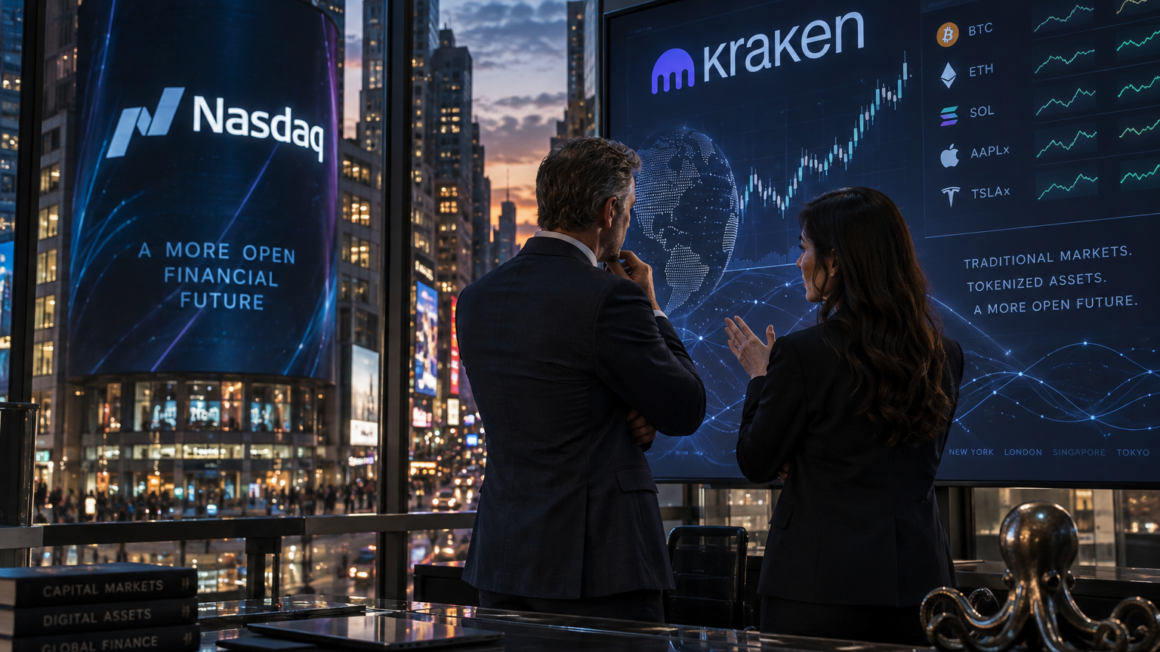
Nasdaq is putting $100 million directly behind Payward, the parent company of Kraken, as their tokenized-equities partnership moves from technical collaboration to strategic ownership. The investment, reported at a $21 billion valuation, gives one of the world’s most important securities-market operators a financial stake in infrastructure designed to connect regulated stock markets with blockchain networks. The Founders’ analysis suggests the more consequential story is not the size of the check, but what Nasdaq appears to be buying into: a future in which equities trade for longer hours, settle faster and increasingly move across traditional and on-chain financial systems.
Nasdaq is deepening its push into blockchain-based capital markets with a $100 million investment in Payward, the parent company of cryptocurrency exchange Kraken, turning an existing technology partnership into a direct strategic financial relationship.
The investment will be made through Nasdaq Ventures, Nasdaq’s strategic investment arm.
Nasdaq confirmed the $100 million commitment on September 10 and said the two companies would expand their work on Nasdaq Equity Tokens, or NETs, while entering into a new market-surveillance agreement. Nasdaq expects the NET infrastructure to launch in the second quarter of 2027.
Secondary reporting has put the Payward valuation attached to the transaction at approximately $21 billion. Nasdaq’s own announcement, however, does not publicly disclose a valuation, ownership percentage or share-class terms, an important distinction when assessing the economics of the investment.
On a simple $21 billion valuation basis, a $100 million investment would mathematically correspond to roughly 0.48% of Payward. That should not be treated as Nasdaq’s confirmed ownership stake because preferred-stock rights, dilution, transaction structure and whether the quoted valuation is pre- or post-money could alter the calculation.
What is clear is that Nasdaq is no longer merely experimenting alongside Kraken.
It is investing in the company building part of the infrastructure.
From Partnership to Capital Commitment
Nasdaq and Payward first announced their tokenization partnership in March.
The companies have been developing what they call an equities transformation gateway: infrastructure intended to connect regulated, permissioned securities markets with blockchain networks that can operate outside the traditional architecture of brokerage accounts and exchange hours.
Payward’s xStocks framework is expected to provide an important part of the blockchain-facing infrastructure.
Under the model announced in March, eligible users could ultimately move tokenized equities between regulated capital-market infrastructure and compatible on-chain environments, subject to jurisdictional and regulatory restrictions. Payward is also expected to provide settlement infrastructure and compliance onboarding in eligible markets.
That partnership has now acquired significantly greater strategic weight.
Nasdaq President Tal Cohen said the expanded relationship reflects Nasdaq’s conviction that Payward can play an important role in building the infrastructure required for the next phase of capital-market development.
The investment therefore looks less like a conventional venture bet on cryptocurrency prices and more like an infrastructure bet on how securities themselves may trade in the future.
Nasdaq Is Not Trying to Turn Stocks Into Crypto
That distinction matters.
The popular description of tokenized equities can make the technology sound as though a stock such as Nvidia or Apple simply becomes another cryptocurrency.
Nasdaq’s proposed structure is more conservative.
Its approach is designed around preserving issuer control, investor protections and the economic rights attached to the underlying security. Nasdaq has repeatedly emphasized that tokenization should operate inside, or connect responsibly with, regulated capital-market structures rather than simply recreate shares as unregulated blockchain instruments.
That approach became considerably more credible in March when the U.S. Securities and Exchange Commission approved Nasdaq’s rule change permitting eligible securities to trade on the exchange in tokenized form as part of the relevant Depository Trust Company pilot framework.
The regulatory approval means Nasdaq is not merely discussing a theoretical tokenization project.
It has already secured an important piece of the market structure required to experiment with tokenized securities inside the regulated U.S. system.
Payward potentially gives Nasdaq something different: connectivity with crypto-native and on-chain financial infrastructure.
That bridge is the strategic asset.
Kraken’s xStocks Has Already Produced Meaningful Volume
Payward also enters the relationship with more than a prototype.
Kraken said in March that xStocks had exceeded $25 billion in cumulative transaction volume less than a year after launch, including more than $4 billion settled on-chain, with more than 85,000 unique holders across supported blockchain networks.
Those are company-reported figures and should be understood as such, but they help explain why a traditional exchange operator would choose to partner with an existing crypto-market infrastructure provider rather than build every component internally.
Nasdaq brings regulated exchange infrastructure, issuer relationships and market-structure expertise.
Payward brings digital-asset distribution, blockchain connectivity, liquidity infrastructure and experience operating markets that do not observe the traditional 9:30 a.m.-to-4 p.m. U.S. trading day.
The combination attacks one of the central questions facing exchanges:
What does an exchange become when assets no longer need to stop moving because a traditional trading session has ended?
The $21 Billion Valuation Is More Interesting Than It First Appears
Payward’s reported $21 billion valuation deserves closer examination.
Kraken raised $800 million in 2025, including a $200 million strategic investment from Citadel Securities at a $20 billion valuation. That represented a substantial increase from a financing completed only months earlier at approximately $15 billion.
If Nasdaq’s transaction is indeed being completed at $21 billion, the headline valuation is only about 5% higher than the $20 billion Citadel Securities benchmark.
That is modest compared with the company’s earlier valuation expansion.
There is another complication.
In April 2026, Deutsche Börse agreed to invest $200 million in Payward for a reported 1.5% fully diluted stake, implying a valuation of roughly $13.3 billion. Around the same period, however, stock consideration used in Payward’s Bitnomial transaction valued Payward equity at approximately $20 billion.
Those numbers demonstrate why private-company valuations require care.
Different transactions can involve different securities, negotiated rights, dilution assumptions, acquisition currencies and strategic considerations. It would therefore be misleading to conclude mechanically that Payward’s value collapsed from $20 billion to $13.3 billion and then surged to $21 billion.
What can be said more confidently is that major financial institutions continue to commit capital at valuations placing Payward among the most valuable privately held financial-technology companies.
And the identity of those institutions is arguably more important than the precise valuation.
Citadel Securities.
Deutsche Börse.
Nasdaq.
These are not investors whose core businesses depend on speculative crypto tokens.
They are market-structure businesses.
Payward’s Financials Help Explain the Interest
The investment case also looks different when Payward is examined as a financial infrastructure company rather than simply as Kraken, the cryptocurrency exchange.
Payward reported $2.2 billion in adjusted revenue for 2025, up 33% year over year, while adjusted EBITDA reached $531 million, an increase of 26%.
Total platform transaction volume reached $2 trillion, assets on the platform stood at $48.2 billion, and funded accounts increased 50% to 5.7 million. Importantly, only about 47% of adjusted revenue came from trading-related operations; approximately 53% came from asset-based and other revenue streams including custody, payments and financing.
At a $21 billion valuation, Payward would therefore be valued at roughly 9.5 times its 2025 adjusted revenue and around 40 times its 2025 adjusted EBITDA.
Those are not directly comparable to conventional exchange valuation multiples because Payward’s reported measures are non-GAAP and its growth profile, asset mix and regulatory risk are materially different. But they provide a useful framework for understanding what the market is pricing.
Payward is being valued not merely on what Kraken earns from today’s crypto trades, but on the possibility that its infrastructure can support a much wider range of assets and financial activity.
The second quarter of 2026 offers some evidence for that strategy.
Payward reported $508 million in adjusted revenue, up 17% year over year, despite total platform transaction volume declining 18% to $310 billion. Funded accounts rose 42% to 6.6 million, while the company remained adjusted-EBITDA positive at $23 million.
The weaker EBITDA figure also shows that the transition is not cost-free.
Payward is spending aggressively on acquisitions, new products, geographic expansion and regulatory infrastructure. Investors are effectively betting that those investments will eventually generate a more diversified and durable earnings base.
Nasdaq Is Buying Access to a Market That Never Closes
The central economic argument behind tokenization is not simply that blockchain technology is fashionable.
It is settlement and capital efficiency.
Traditional securities markets still contain multiple layers of brokerage, clearing, custody and settlement infrastructure.
Nasdaq and Payward argue that properly structured on-chain settlement could reduce some of the time and collateral tied up between execution and final settlement.
Payward Co-CEO Arjun Sethi noted that more than $2 trillion of stock trades pass through the U.S. clearing system each day, with trades heavily netted before settlement. Nasdaq’s announcement said $10 billion to $20 billion of collateral can remain tied up against the residual exposure during the settlement process.
The industry’s move from two-day settlement to one-day settlement in 2024 already demonstrated that shortening settlement periods can release capital.
Blockchain advocates want to take that logic further.
The long-term vision is a market in which securities can move continuously, settle closer to real time and potentially serve as programmable collateral across different financial applications.
Whether that vision works at institutional scale remains unproven.
But Nasdaq is now spending money to help find out.
Market Surveillance May Be the Most Important Part of the Deal
The $100 million investment attracted the headline.
The surveillance agreement may prove just as significant.
Payward will adopt Nasdaq’s market-surveillance technology across its portfolio of trading venues, covering crypto, equities, tokenized equities, futures and options.
That is strategically important because tokenization cannot achieve mainstream institutional adoption merely by making assets transferable on a blockchain.
Markets still require mechanisms for detecting manipulation, abusive trading, suspicious activity and other conduct capable of damaging price formation and investor confidence.
Nasdaq has spent decades operating and selling that infrastructure.
Payward has spent more than a decade operating digital-asset markets.
Their partnership increasingly appears to be an attempt to combine the best features of both systems:
the continuous and programmable characteristics of crypto markets with the surveillance, governance and investor protections associated with regulated securities markets.
That is a much bigger proposition than putting stocks on a blockchain.
Payward Is Quietly Becoming Infrastructure for Traditional Exchanges
Nasdaq is not Payward’s only major exchange relationship.
Germany’s Deutsche Börse invested $200 million in Payward in April.
Earlier this month, London Stock Exchange Group announced plans to work with Payward on tokenized UK equities, with xStocks expected to participate in the LSE 24 ecosystem in 2027, subject to regulatory approval.
Taken together, those relationships point to an emerging strategy.
Payward appears to be positioning itself not merely as a competitor to traditional exchanges, but increasingly as an infrastructure provider and interoperability layer for them.
That model could be considerably more valuable than competing for crypto trading fees alone.
If traditional exchanges conclude that portions of their markets will eventually operate on blockchain rails, they face a strategic choice: build everything internally, acquire crypto-native infrastructure, or partner with platforms that already possess it.
Nasdaq has now chosen both partnership and ownership exposure.
What the Deal Means for Kraken’s Eventual IPO
The investment also arrives while Payward’s public-market ambitions remain unresolved.
Kraken confidentially filed for a U.S. IPO in late 2025 but later paused the process amid difficult market conditions. Reuters reported in March that the company had frozen its listing plans, without abandoning the possibility of going public at a later stage.
A strategic investment from Nasdaq creates an unusual backdrop for any eventual flotation.
The operator of one of America’s largest public stock exchanges is now financially aligned with a company that could itself eventually become publicly traded.
More importantly, institutional relationships with Nasdaq, Deutsche Börse, Citadel Securities and LSEG could strengthen Payward’s argument to public investors that it should not be valued simply as a crypto exchange.
Its preferred narrative is becoming clearer:
Payward wants to be valued as financial infrastructure.
That distinction could determine whether public investors eventually view it primarily through the volatile economics of cryptocurrency trading or through the much larger opportunity presented by global multi-asset markets.
The Founders’ View
Nasdaq’s $100 million investment is small relative to a reported $21 billion valuation.
Its strategic significance is considerably larger.
For years, traditional finance and crypto were presented as competing financial systems.
The more important development in 2026 is that the boundary between them is beginning to disappear.
Nasdaq is developing tokenized securities.
London Stock Exchange Group is working with Payward.
Deutsche Börse owns a stake in Payward.
Kraken is expanding beyond cryptocurrencies into equities, derivatives, payments and institutional infrastructure.
The emerging contest is therefore no longer simply Wall Street versus crypto.
It is a competition over who controls the infrastructure connecting both.
Payward has spent years building from the crypto side toward traditional finance.
Nasdaq is approaching from the opposite direction.
Its investment suggests the two may increasingly meet in the middle.
If Nasdaq Equity Tokens launch as planned in 2027 and regulated securities begin moving between conventional markets and blockchain-based environments while retaining shareholder rights, the $100 million investment may ultimately be remembered less as a venture-capital transaction than as an early ownership stake in a new layer of global market infrastructure.
For Nasdaq, that is the opportunity.
For Payward, it is also the test of whether Kraken can evolve from one of crypto’s oldest exchanges into something considerably larger: a core infrastructure company for markets that increasingly never close.